In my humble opinion the color “Orange ” can make majority of us Happy. Think… That orange winter jacket, a pair of orange sneakers, an orange beach towel, an orange shirt .. .list goes on. We love wearing bright colors because they make us happy. We also have our favorite vegetables. […]
Although I have always been more of a rock/jazz fan, as an aspiring musician…which I was as a pre-teen…I ventured into all genres of music. That way I discovered that I did fancy many other styles and studying them taught me a lot. But in the 1970’s my family had moved me to the United States…Miami to be precise…and that was the era of AM music.
(Pintertest image)
Miami had two competing stations on the AM dial, WQAM and WFUN and I, like all the other lads listened to both.
(Flickr image)
(public domain photo, unknown origin)
(Notice the number 6 song in the first survey and the number 7 song in the second one…)
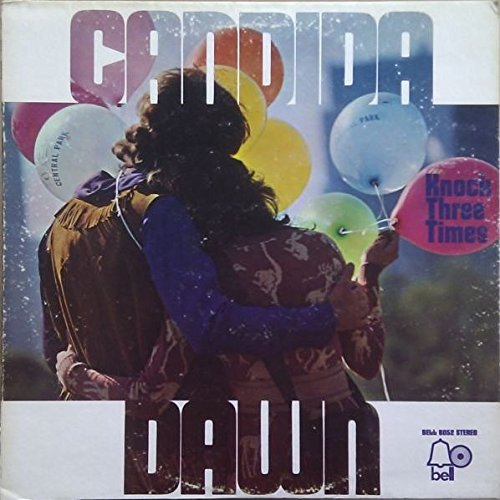
That’s how I got into this type of «pop» music and well, Tony Orlando and Dawn was big for a few years. So I developed a taste and my favourite song from them was «Candida». And since I liked it and it is an «oldie» I am featuring it for all of you.
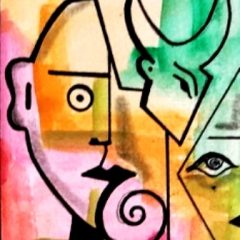
(Digital Art image property of FBC, Omnia Caelum Studios Valencia, All Rights Reserved)
So what is «digital art» or how I prefer to say it «Art Digital«? Well it may be different things to different people and a different technique or process for every artist or photographer out there. But for me it is the work I am placing in my new website at Pixels which I invite you to visit by clicking on the link for Bodo Vespaciano and tell me what you think. I know, it is still a work in progress yet not unlike my other «Art Digital» site at Fine Art America under my «other» name of Francisco Bravo Cabrera (we’re the same person, Bodo and me, I am sure you know by now).
These platforms are new to me and I do not sell any original work through them, I use them only for prints and for other merchandise that they have and on which they can apply the digital art that I place in my site.
For my original artwork, I invite you to visit my Instagram:(@Francisco_Bravo_Cabrera and/or my representative @Guloshka) And I would just like to say that all of my artwork is for sale, and if you DM me on my Instagram (or Guloshka’s) we can give you more information as there are many that already have been sold.
So, as these sites, Pixels and Fine Art America are new to me, I would really appreciate any and all information, feedback and even instructions on how to fully utilise them properly and effectively.
(«Reflections», oil/acrylic on canvas, Image property of FBC, Omnia Caelum Studios Valencia)
I had very little time to work while in Madrid but I managed to convince a friend to lend me her studio, and this was the result. «Reflections» measures 180x200cm and I did it mostly with acrylics, but since there were some good oil paints around…and lots of windows…I decided to mix the media a bit. I had done this before when I was working in Miami so I knew quite well how to get the most out of it.
«Reflections» is not an abstract as it clearly has a figure, that of the «moon», or so it would seem. The idea of the reflection comes from the fact that the moon, in all its aspects, reflects the majesty of the seas and the sea is reflected on every aspect of the moon. Is it a mirror in the heavens?
So what is the meaning of this painting? Well, from a philosophical point of view, it speaks of cosmology, of the origins of mankind, of humanity. Life surged from the sea…according to evolutionists…and then made its way to dry land. I say that from a more mystical/spiritual point of view, the power of the sea, the creative energy, selected by the divine creator of the universe, gave birth to the first man…
African religions speak of Yemaya, goddess of the sea…the Mother of all those who love her and whom she loves…and in my own Christianity, Mary, the Mother of God, is called Stella Maris, the Star of the Sea.
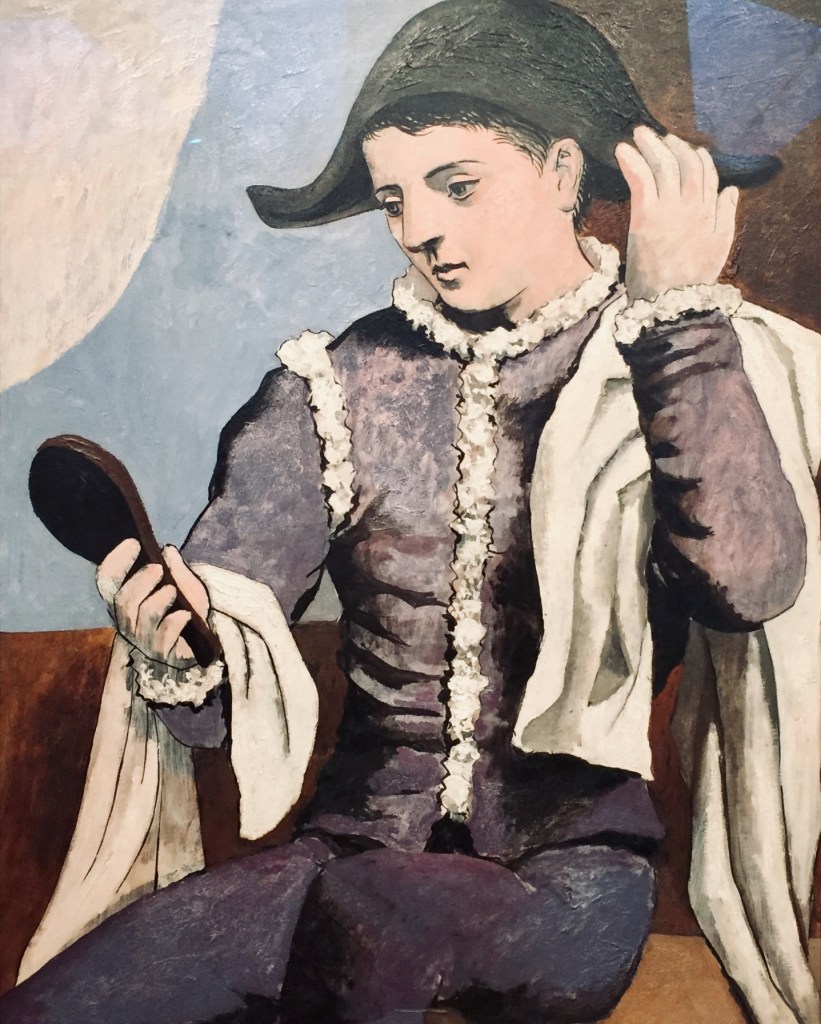
(«Arlequín con espejo», «Harlequin with Mirror», foto propiedad/Photo property: FBC, Omnia Caelum Studios Valencia)
Este cuadro pintado en 1923 lo he disfrutado mucho. Lo vi en el Thyssen durante mi recién visita a Madrid. Aquí Picasso estaba cambiando de estilo, mas o menos, y se re-ajustaba al arte clásico, aunque no en los temas, pues había visitado Italia con Cocteau y vino muy inmerso en los clásicos.
Se piensa…por los rayos X…que este cuadro iba ser un autorretrato, inspirado por Arlequín, pero terminó con la máscara de Pierrot, y con un aspecto un tanto melancólico. Pero no vayáis a pensar que Picasso se convirtió en un clásico cualquiera, nada que ver, se siguió saltando las reglas. Bueno, al fin y al cabo era un genio…
Para los artistas…
Quiero que notéis el uso de los colores, como Picasso aplicó la teoría del color. También, podéis notar la manera de crear una composición al estilo clásico, pero usando una temática contemporánea, o una que no sea clásica. Las reglas del color, de la composición y del estilo se aplican para que el cuadro logre un tema valido, para que diga algo y para que exprese la filosofía del autor. Para eso, que mejor ejemplo que un Picasso…
I saw this work, painted in 1923, during my most recent visit to the Thyssen in Madrid and I greatly enjoyed it. Here Picasso was changing his «style» and seemingly was re-adjusting to the classical style, although not in the subject matter. He had just returned from Italy with his friend Cocteau and had re-immersed himself in the classics.
We think…according to X ray analysis…that this painting was going to be a self-portrait, inspired upon Harlequin. However, it ended up being a Pierrot with a face a bit melancholic. Now do not think that Picasso had become a classical painter, no, not at all. He continued to skip over the rules, after all he was a genius…
To the artists…
I would like you to notice Picasso’s use of colour, in accordance with the theory of colour and how he mixed them. You can also take note of how he composed the painting in the classical style but with a contemporary subject matter. The rules of colour and composition are very important in creating a work of art that reproduces a valid theme, that expresses ideas and emotions and that pushes forward the philosophy of the artist. For this, what better an example than a Picasso…
(Photo property of FBC, Omnia Caelum Studios Valencia, All Rights Reserved)
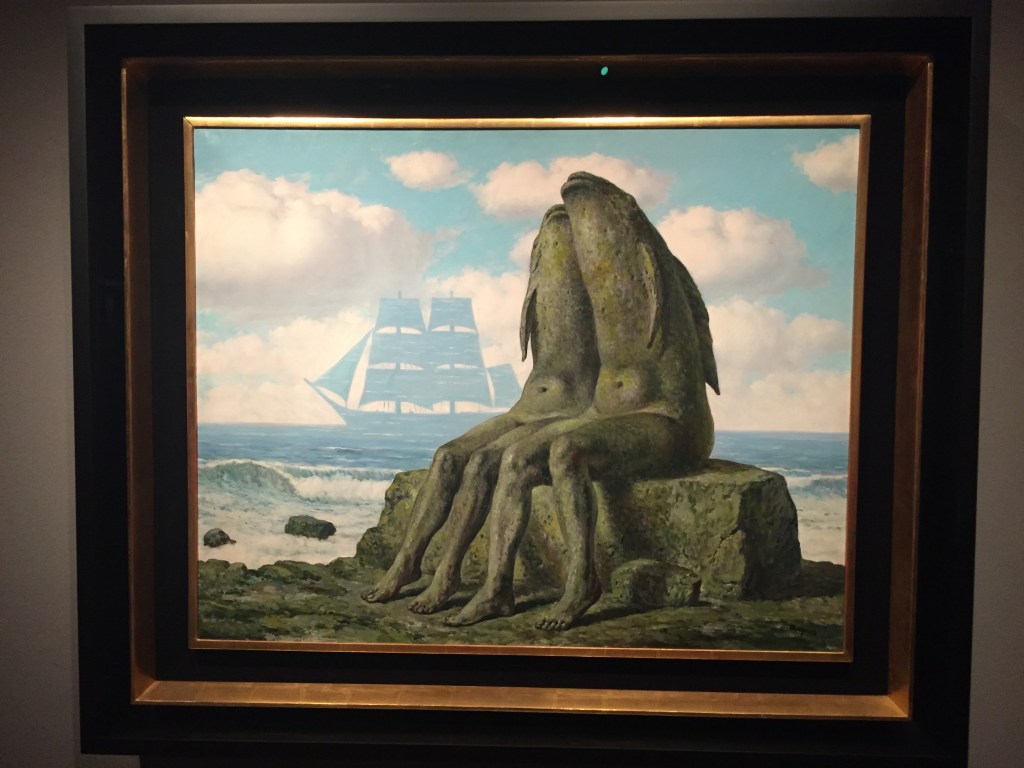
I had been waiting for this exhibition for the whole of last year and finally I got to see it just a few days before its January 30th closing at the Thyssen Museum in Madrid. So here are some of the paintings they had. I did not put them all in the video because it would have been too long but in days to come I will feature part two…
(Comments always welcome and appreciated, as well as likes and shares. Thank you!)
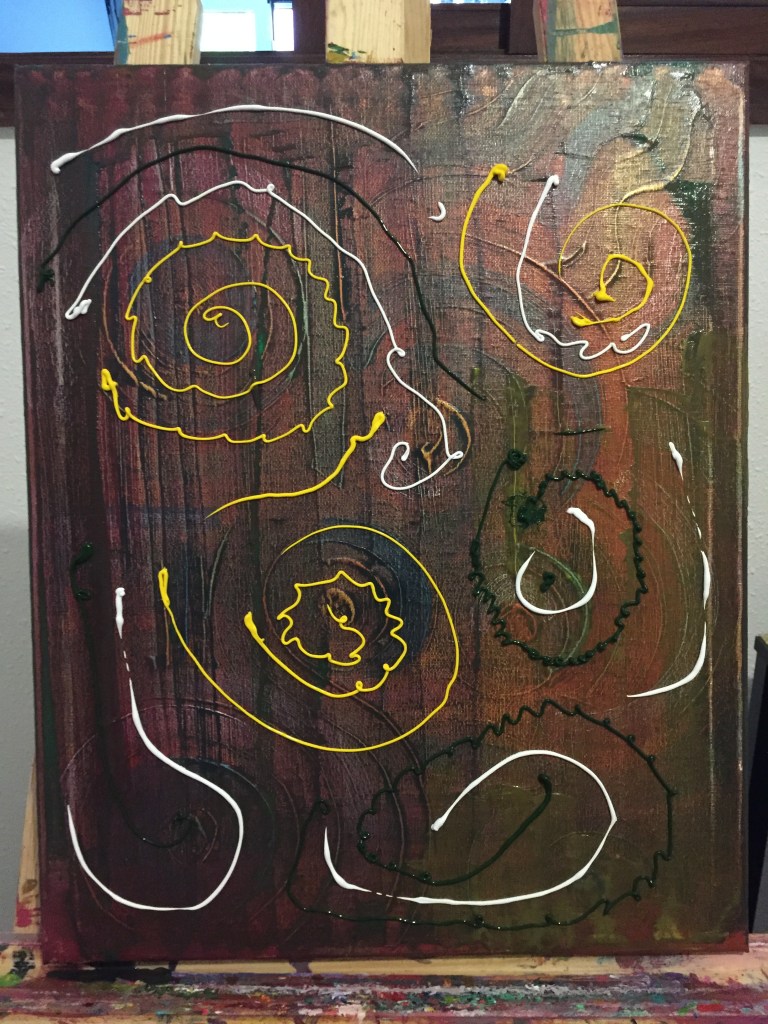
(«Abstract #123», acrylic on canvas – image property of FBC, Omnia Caelum Studios Valencia, All Rights Reserved)
* But you can easily skip them or break them…
However…
There is a rule that must not be broken…Rule #1…and that is that every brushstroke should be applied to the canvas with thought and with a specific purpose in mind. There should be no randomness in the manner in which paint is applied. Yes, at first, random brushstrokes are admitted…and even encouraged…but when you are finally shaping the structure of the composition, each brushstroke should be carefully thought out and purposely applied. This rule should not be broken because if you do, you will not be putting the thoughts into the composition that it requires. After all, I am assuming that you did put thought, intention, message and emotion into your composition in the first place…
And…
This rule…as all other rules…applies to figurative as well as to abstract art. I have often said that abstract art is the most difficult art to do…to do right…because the reference is internal, therefore it is very important that Rule #1 be followed diligently. Now, if you consider the example I have placed above, you might think that there is a lot of random dripping of paint…unmixed paint right out of the tube…and that little thought was given to where it would end up on the canvas. But you would be wrong. Like I said, the reference…for me, as the one who painted it…is internal, so it can change according to how I «see» this reference within my head. Yet the reproduction of it on the canvas remains faithful to the reference. And please do not confuse this with what the observer may, or may not, see when looking at the painting.
I chose not to give this painting a word title and instead I chose the number 1,2,3, as they, in their union, as a number, 123, stand in place of a philosophical concept, which I will not go into here, but it is meaningful to me. Nothing is random, nothing is intuitive, as intuition does not lead to a finished work of art.
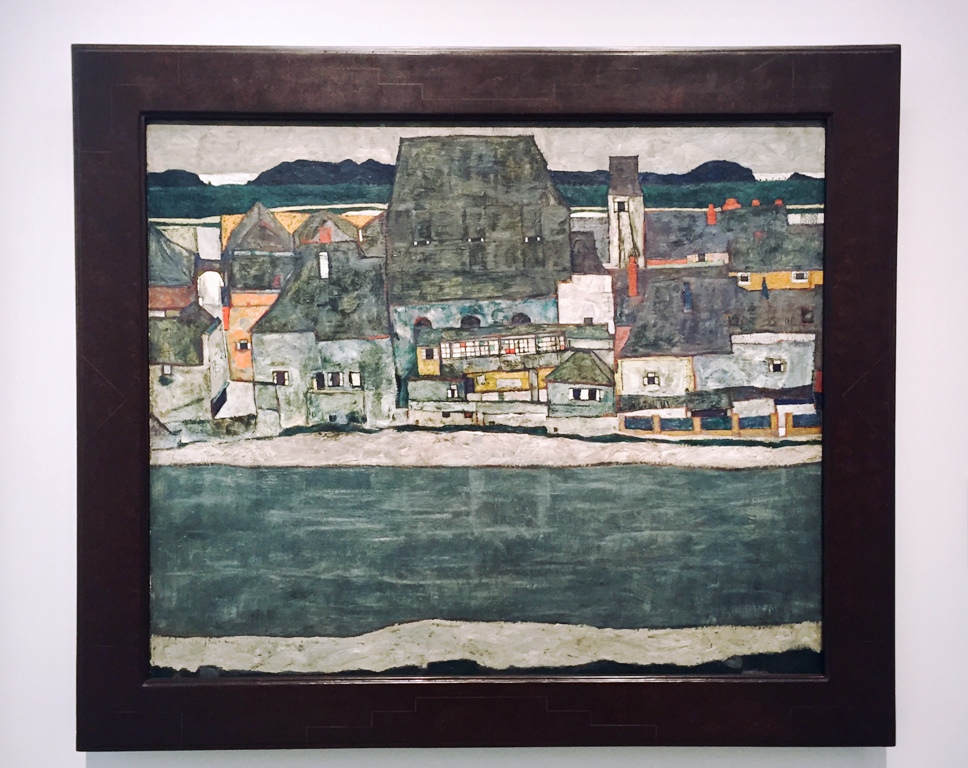
Ya os he ofrecido unvídeo acerca de la obra de Egon Schiele, (ver el vídeo) uno de mis favoritos de los expresionistas alemanes, aunque era austriaco. Hoy quiero presentaros esta obra que he visto en el Museo Nacional Thyssen-Bornemisza de Madrid que muestra una forma diferente que uso Schiele para expresar su creatividad y su filosofía en el arte.
(«Casas junto al rió», oleo sobre lienzo, 1914/»Houses on the River», oil on canvas, 1914 – Foto propiedad de FBC, Omnia Caelum Studios Valencia/Photo property of FBC, Omnia Caelum Studios Valencia)
I have already offered you all a video on Egon Schiele, one of my favourites of the German Expressionists, although he was Austrian. But today I want to bring you one of his works that I saw at the Museo Nacional Thyssen-Bornemisza de Madrid that will show you a different type of work, a different way in which he expressed his creativity and his philosophy in art.
Egon Schiele: 1890-1918, pintor expresionista. En 1906 se matriculó en la Academia de Bellas Artes de Viena y en 1907, a los17 años de edad, buscó a Gustav Klimt, (ver el vídeo), que se interesó en Schiele y le compró sus dibujos. Schiele expuso su obra en exposiciones colectivas en Praga, Budapest, Colonia y Munich de 1910 a 1912, también fundó el Neukunstgrupped (Grupo nuevo de arte) donde participó otro gran expresionista austriaco, Oskar Kokoschka. Schiele murió durante la pandemia de la influenza de 1918.
Egon Schiele: 1890-1918, expressionist painter. In 1906 he enrolled in the Vienna Fine Arts Academy. In 1907, at the age of seventeen he looked for Gustav Klimt, (see the video), who became interested in his work and bought Schiele’s drawings. From 1910 to 1912, Schiele exhibited his work in Prague, Budapest, Cologne and Munich and founded the group Neukunstgrupped (New Art Group) where Oskar Kokoschka also participated. Schiele died during the pandemic of 1918 of influenza.




/egon-schiele-5bd8a96a46e0fb00510a25e9.jpg)
 JaZzArt en València