#art, Hammershøi – artista … Hammershøi – Artist

(Image source: Sotheby’s)

Vilhelm Hammershøi (Copenhague, 1864–1916) Pintor danés conocido por sus interiores silenciosos, «El pintor del silencio» le llamaban. Su paleta era muy reducida para no restarle la importancia que tenían para él las líneas, y su atmósfera era muy enigmática. Desde joven mostró talento artístico y estudió en la Real Academia Danesa de Bellas Artes. Trabajó principalmente en su ciudad natal, donde creó retratos, paisajes y, sobre todo, sus célebres escenas de interiores: habitaciones austeras, figuras de espaldas y una luz tenue que se convirtió en su sello personal. Su esposa, Ida Ilsted, aparece con frecuencia en sus obras, usualmente de espaldas, añadiéndole un toque de misterio a la obra. Aunque su estilo fue considerado inusual por algunos contemporáneos, obtuvo reconocimiento internacional temprano y hoy es visto como una figura clave del simbolismo nórdico.

+++

Vilhelm Hammershøi (Copenhagen, 1864–1916) was a Danish painter celebrated for his quiet, minimalist interiors and muted color palette. «The painter of silence» as he was known. Showing artistic promise early, he trained at the Royal Danish Academy of Fine Arts and spent most of his life working in Copenhagen. His most iconic works depict sparsely furnished rooms, subtle light, and figures turned away from the viewer—often his wife, Ida Ilsted—creating a sense of mystery and introspection. Although his restrained style differed from the bold trends of his time, he gained early international acclaim and is now recognized as a major figure in Nordic Symbolism.

+++

(Image source: Museo Nacional Thyssen-Bornemisza)
(Image source: Vogue España)

GRACIASCHEERS

#art, A Page from Art History: Masaccio

(«Retrato de Masaccio»/Francisco Bravo Cabrera/All Rights Reserved)

MASACCIO

Today I would like to talk to you about an Early Renaissance painter from Italia that no one talks about a lot but who is important for art history and I think you should know more about him, or if you do not know anything about him, you should…

Masaccio, born Tommaso di Ser Giovanni di Simone in 1401 in San Giovanni Valdarno, in the region of Tuscany. He died in Rome in 1428…

Masaccio was a painter of the Early Renaissance who, although he had a brief career, transformed the course of Western art. He was born near Florence, and he trained in Florence. Masaccio quickly gained recognition for his innovative use of perspective, naturalism, and light. He rejected the Gothic stylization which was still common in his time. Masaccio was a pioneer of a new visual language that emphasized three-dimensional space, volumetric figures, and psychological realism.

His most important works include the Brancacci Chapel frescoes in Santa Maria del Carmine, Florence, where scenes such as The Tribute Money and The Expulsion from the Garden of Eden demonstrate his mastery of perspective, emotion, and storytelling. He also collaborated with Masolino and may have been influenced by Brunelleschi and Donatello, as he shared with these Renaissance greats an interest in proportion and classical harmony.

Masaccio’s career was tragically short as he died when he was about 26 or 27 years of age. However, his innovations surely influenced later masters such as Fra Angelico, Filippo Lippi, and especially Michelangelo. It can be safely said that Masaccio’s work marks the true beginning of Renaissance painting, bridging the medieval and the modern.

I think you will agree with my assessment of this great Italian master.


(San Giovenale Triptych/1422/Public Domain/Image source: Wikimedia Commons)
(Holy Trinity/1425/28/Public Domain/Image source: Wikimedia Commons)
(Crucifixion/1426/Public Domain/Image source: Wikimedia Commons)

CHEERS

D R A W I N G from the depths of my mind…

(JaZzArT drawing by Francisco Bravo Cabrera/property of FBC/Omnia Caelum Studios Valencia/All Rights Reserved)

I love to teach, (seen my video series on Art History? No? Follow the link, (there’s another one below), but there are some things that I just won’t teach to artists, or students, or art lovers, and that is how to draw. To learn to draw you have to take classes specifically geared at getting you acquainted with the different forms of graphite (pencils), charcoal, Conté Crayons, pastels etcetera etcetera. Then you learn to «see» and to «look» at your subject. Classes are good because they usually have models and I cannot do that from this blog…

But I will say that there are a few things that I can reach out and teach from this vantage point of mine, i.d. my blog, and that is I can try to guide you to think as an «artist» (whatever that is). First, there has to be an incredible urge to express, to reach out, to talk to someone out there, or to everyone. Musicians do that, and of course, their method (song, musical piece) is much more immediate, but we can do that with our art as well, now much easier thanks to the Internet.

Second, you have to know how to dominate and master your craft. That comes only with practice and time. And intimately tied to that is the development of talent. Talent is not something magical that is given to some and denied to others. Talent is a muscle that is developed through hard work. The more you draw the better you get, the more talented you get. Ever heard of «practise makes perfect»?

Don’t worry too much about creativity, imagination, originality or other such terms used by many to talk about art. Art does not depend upon creativity or on the artist’s imagination. And originality? What is that? Is there anything that has not been done before? Originality is not important. What is important is how you approach your subject matter and how you bring it to life on the canvas or the paper or with clay, bronze or even gold.

Art is created by the artist as a discipline, as a job well learned and well developed. It does not flow intuitively, like a child would do. And yes, intuitive art exists but it should exist solely as an experiment, or an exercise. But mainly as a way to get to a real work of art, which is something contrived and controlled, from beginning to end, by the will of the artist.

Here are some examples of some of the drawings I have been working on lately. Notice the line, and notice the development of the composition and how, after you know where your drawing is going, shadows are created, lines are reinforced or removed, altered, changed, in other words, turning the sketch into a finished work. And, of course, these are exercises, they are meant to be a finished work, but not something other than that, being a fully developed idea.

Cheers…

UN LLAMADO A POETAS Y ESCRITORES: VENID…

(Diseño gráfico de Francisco Bravo Cabrera/Derechos Reservados_

Comenzamos el año, y la temporada 2026, de la revista online LatinosUSA (English/Español) que os invita a colaborar con nosotros. Somos parte de la gran red de revistas online bajo el sello de MASTICADORES, creada por nuestro editor y jefe, Juan Ré. Llamamos a poetas, escritores y artistas que participan en cualquiera de las bellas artes para invitaros a publicar en nuestra revista. Publicamos diariamente.

Y a ti, si te interesa, únete a nuestro extenso grupo de colaboradores del mundo entero. Mándame un email y te explicaré el proceso.

Francisco Bravo Cabrera, editor de poesía: ArribaPamplona@gmail.com

GRACIAS

Bon dia!

Que lastima que no exista esa reflexión…

#art, Aquí un poquitín de arte surreal Jazz! Here a Bit of Surreal Jazz-Art

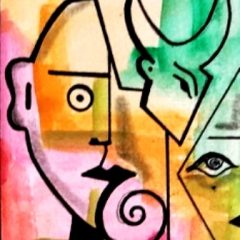
(Detalle de un cuadro de Francisco Bravo Cabrera/Derechos Reservados/All Rights Reserved)

El arte no es para pensarlo, es para comerlo…

Art is not for thinking, it is for eating…

GRACIAS – CHEERS

#art, Arte comible – Edible Art

(“Ella”/Francisco Bravo Cabrera/All Rights Reserved)

El arte no es para entenderlo es para comérselo y disfrutar de su sabor…

+++

Art is not to be understood, it is to be eaten so you can taste its flavour in your mouth…

(FBC at the studio/All Rights Reserved)

GRACIAS – CHEERS