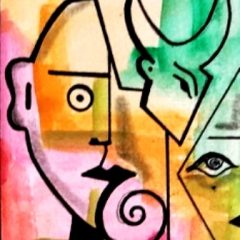

“Comfort Me”
(While listening to Handel’s “Messiah”)
A voice breaks the silky silence of the morning,
It’s a subtle breath that’s all,
that whispers hope
where dust had learned only despair.
The clouds caress the valley
and it stretches before me,
the roads are straight,
the mountains bend,
and I remember,
the light returns,
I hear the voice I had had forgotten,
and the trumpets that were not meant to conquer but to awaken me from dreams.
A lamb walks forward crowned in Holy blood,
while the powerful unlearn the grammar of their thrones.
Grief kneels and becomes praise.
A prayer becomes intention and
chains dissolve as trust regains its place among my favours.
Death itself inhales and finds no soul to claim,
for life has learned to sing beyond the grave.
And when my heart,
My voice,
My will,
Chants the final “Amen”,
it fills the air,
nothing ends
the curtains open.
The sun dances in
And life begins.
(C.2025, Francisco Bravo Cabrera – 25/12/2025 – Valencia, España)
+++++++++++++++++
Messiah is an English-language oratorio. It was composed by Georg Friedrich Händel in 1741. Oratorios are unstaged musical works for orchestra, choir, and soloists, typically on sacred subjects. Messiah is not a narrative drama with characters interacting onstage. It is a contemplative, scriptural meditation.
The libretto was compiled by Charles Jennens based solely on biblical texts taken primarily from the King James Bible and the Book of Common Prayer. The work is structured in three parts:
• Part I reflects on prophecy and the birth of Christ.
• Part II focuses on suffering, crucifixion, resurrection, and redemption.
• Part III contemplates the promise of resurrection and eternal life.
Musically, Messiah is a sublime balance between lyrical intimacy and choral writing. Handel’s chorus is a theological voice that proclaims, reflects and rejoices. The famous “Hallelujah” chorus is the epitome of this synthesis of grandeur, clarity, and emotional directness.
+++++
Something about the composer
Georg Friedrich Händel (1685–1759) was born in Halle, Germany. He is one of the most important Baroque composers. He spent most of his professional life in England and became a naturalized British citizen.
Although he was initially trained in law, due to his father’s insistence, his love for music soon prevailed. He worked in Germany and Italy then settled in London. There, although he achieved great success as a composer of Italian opera, he, because of financial pressures, later focused entirely on English oratorios. And he excelled.
Handel should be recognised for his productivity, adaptability, and dramatic instinct. Despite periods of illness and professional difficulty, he remained creatively active until late in life.
Messiah was composed in London (1741). It took him only twenty four days to finish the score. Need drove him as his Italian operas were losing popularity in England.
The impetus for Messiah was an invitation to present a series of concerts in Dublin. Charles Jennens had already prepared the libretto, intending it as a serious theological reflection rather than theatrical entertainment. Händel accepted the project. He focused on it with intensity and strength.
And so Messiah was first performed on 13 April 1742 in Dublin, at the Great Music Hall on Fishamble Street, as part of a charity event benefiting prisoners, hospitals, and the poor. The premiere was well received, though Messiah would take time to achieve its later iconic status.
Notably, Messiah was initially more successful in Ireland than in London, where some objected to sacred texts being presented in a concert setting. Over time, however, it became one of the most frequently performed and enduring works in Western music. It is still loved and performed during the Christmas season.
CHEERS
 JaZzArt en València
Beautiful, Francisco.
Me gustaLe gusta a 1 persona
Thank you 🙏🏻 Pat!
Me gustaLe gusta a 1 persona
My pleasure, Francisco
Me gustaLe gusta a 1 persona
🙏
Me gustaLe gusta a 1 persona
Absolutely Beautiful Brother. It feels honest and lived in. Comfort rising out of grief, hope waking the heart again.
Me gustaLe gusta a 1 persona
Thank you so much Brother! And all the best to you!
Me gustaLe gusta a 1 persona
You are very welcome…
Have a Wonderful Weekend…
Me gustaLe gusta a 1 persona
You too Brother!
Me gustaLe gusta a 1 persona
This is a luminous and deeply moving piece. The poem captures the spirit of Messiah not by retelling it, but by listening to it from within—allowing the music to become breath, landscape, memory, and awakening. Your imagery is both tender and bold: grief transforming into praise, power unlearning itself, life singing beyond the grave. It feels contemplative rather than declarative, which mirrors the true nature of Handel’s work beautifully.
The accompanying reflection on Messiah and Handel adds thoughtful context without diminishing the poetry’s quiet power. Together, the personal meditation and the historical insight form a harmonious whole—much like the balance of intimacy and grandeur you describe in the oratorio itself.
Me gustaLe gusta a 2 personas
Good morning Sir and thank you 🙏🏻 your comment is very much appreciated and I am truly grateful. Your words add much to the meaning of the poem. Wishing you a most wonderful day in peace and creative energy!
Me gustaLe gusta a 1 persona