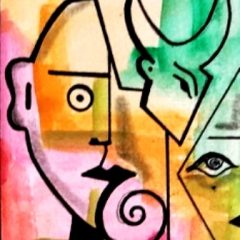

When I started uni as a Fine Arts major conceptual art, in other words, performance art, was pretty strong. We had the performances of Marina Abramović and Ulai as well as of others. And of course we all knew about the conceptual «art» of Yoko Ono. But in our art school we had no classes, nor where we ever led towards that branch of «art.» And even when I switched to the Theatre Arts Department, the university did not consider teaching classes on how to be a performance artist. And I think they had the right approach. To me, in my opinion, performance art is more akin to theatre than to art, and conceptual art is more akin to nothing. I’ve no use for it. It is simply a way for talentless «artists» to «create» art that no one understands and that says nothing important. And do not forget, these are my personal feelings and opinions. Yours might be different and I will respect them.
So, here is a comparison:
| Aspect | Traditional Art | Conceptual Art |
|---|---|---|
| Primary Focus | Skill, technique, and aesthetics (form, color, composition, craftsmanship) | Idea, concept, or social statement; the concept is often more important than the execution |
| Materials/Execution | Paint, marble, bronze, canvas, musical instruments—mediums require mastery | Anything: instructions, text, objects, performance, ephemeral materials; mastery of medium is often secondary |
| Immediate Impact | Often visually or emotionally striking; can communicate without explanation | Often obscure; may require reading instructions or context to understand the meaning |
| Accessibility | Easily appreciated by general audiences; universal visual or auditory appeal | Often appeals to a niche audience familiar with art theory*; can feel confusing or silly to outsiders |
| Longevity | Objects are permanent or durable; intended to last for centuries | Often ephemeral, performative, or instructional; may exist only as documentation or memory |
| Emotional Engagement | Direct: beauty, awe, empathy, or emotional resonance | Indirect: intellectual engagement, provocation, or philosophical questioning*. |
| Risk of Misunderstanding | Lower: people “get it” on sight | High: without explanation, work may seem meaningless or trivial |
| Evaluation Criteria | Technical skill, composition, beauty, originality | Originality of idea, conceptual clarity, provocation, challenge to norms |
| Famous Examples | Michelangelo, Rembrandt, Vermeer, Monet, Beethoven, Stravinsky | Yoko Ono, Fluxus artists, Duchamp, Sol LeWitt, Abramović |
| Criticism | Can be conservative or formulaic; sometimes prioritizes aesthetics over ideas | Can appear pretentious, naive, or inaccessible; sometimes “idea-heavy” and lacking sensory impact |
* I strongly disagree as I think it is pretentious, naive, meaningless and a useless experiment in elitism displayed as mediocrity. It might be interesting for the performer or the conceptual «artist» but pure rubbish to the rest of us.
What they teach at uni (nowadays) is that traditional art emphasises skill, execution and sensory impact (and I agree). And that conceptual art emphasises ideas and provocation, often at the cost of immediate clarity or beauty. Well, only very few of them bring forth ideas or provocation, some are just self-indulging machinations by talent-less «artists» having us all on.
 JaZzArt en València
This is a bold and thought-provoking reflection. 🌟
What stands out is the honesty and clarity with which you share your personal experience and perspective on conceptual and performance art. Your comparison between fine arts and theatre is not only sharp but also rooted in your own journey through academia, which gives your words authenticity.
I especially appreciate how you openly acknowledge that these are your own views while respecting others who may feel differently. That balance of conviction and openness is rare and makes your writing engaging.
Me gustaLe gusta a 1 persona
I truly appreciate your kind words Sir, very much! Thank you so much and I am so glad that this comparison piece has resonated with you. All the best!
Me gustaLe gusta a 1 persona
Thank you so much, Sir.
I’m truly glad to hear that, and it’s wonderful to know the piece resonated with you as well. Wishing you continued inspiration and all the best in your creative endeavors!
Me gustaLe gusta a 1 persona
You are most welcome Sir, and yes, I wrote the piece which is reference a subject concerning my profession as an artist, a traditional artist. I truly thank you Sir!
Me gustaLe gusta a 1 persona
Spot on, Francesco! Thank you!
Joanna
Me gustaLe gusta a 1 persona
Thank you Joanna!
Me gustaMe gusta
You are welcome, Francesco!
Joanna
Me gustaLe gusta a 1 persona