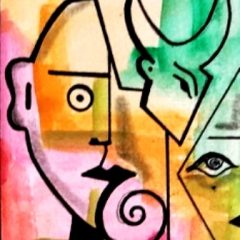
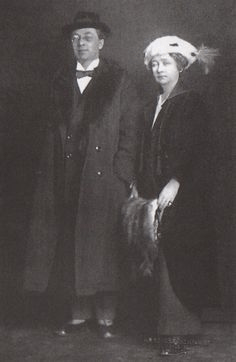
Welcome to the final episode (pt.3) of Kandinsky. The reason why I stretched Kandinsky out so much is because he is one of the most important artists in art history. Not only because of his development of abstract art (yes, we all know that Hilma af Klint* and Anna Cassel and Georgiana Houghton painted some abstracts before him), but because he was an art philospher and theoriser as well. And he might not have the title of the inventor of abstract art any more, but he certainly was the one who brought it to the vanguard and made it popular. Af Klint did nothing with her work, whereas Kandinsky created a movement in art that is still quite vigorous and healthy to this day.
* Let’s take a look at the work of Hilma af Klint and you tell me if it qualifies as an art form to defy and dethrone Kandinsky…
«The impulse towards abstraction finds its joy in inorganic beauty, in that which is governed by abstract laws and necessities.» Wilhelm Worringer (1881-1965) German art theorist and historian.
Kandinsky’s justification of abstract art, as well as his move towards abstraction, is justified in Worringer’s book «Abstraction and Empathy: Essay in the Psychology of Style» (1908). Kandinsky, as well as Worringer, thought that artists must create from their own reality and that conjures a certain abstract impulse being that European artists exist in a non-materialist world (except for communists). He was also interested in Theosophy, the belief in a hidden, but essential reality, that lies behind appearances. This opens the way to rationalise and to develop abstract art.
In 1911 Kandinsky published his book «Concerning the Spiritual in Art«. This is a must for all art students and self-taught artists. Kansdinsky really puts all the previous notions of art upside down. This book truly describes the foundations of the abstract art movement in their theoretical form. He talks about a coming spiritual age and the participation of art within it. His main argument is that colour should be the basis of the new art form and the spirituality of each colour and how they are received by the soul. Kandinsky does not bother to expound on the previously accepted colour theories but instead of the soul’s response to the colours used.
Kndinsky painted (between 1926 and 1933) 159 oil on canvas paintings and 300 watercolours. The Nazis, of course, declared his paintings to be decadent and degenerate art and many of his paintings were lost. In 1939 he became a nationalised French citizen.
Of course there is much, much more to Kandinsky, but the rest I am sure you will enjoy researching on your own. The most important thing to take away from this series is that art history is very important to all artists, especially students, and that art has a philosophical, theoretical aspect to it which is very important. Kandinsky proves both as he was a phenomenal visual artist as well as a phenomenal writer, philosopher (of art) and theoriser. That is why he is my second pillar fo art (my first being Picasso).
Here is a post from the past you might find interesting concerning the good and the bad in abstract art…
CHEERS…
 JaZzArt en València
Me gusta su obra. Feliz día de Reyes
Me gustaLe gusta a 3 personas
Gracias Azurea20!
Me gustaMe gusta
Beautiful 🙏
Me gustaLe gusta a 3 personas
Thank you! 🙏🏻
Me gustaLe gusta a 2 personas
🌹
Me gustaLe gusta a 1 persona
Thanks for telling us more about one of your favourite artists F. It’s always interesting to learn more about this subject.
Me gustaLe gusta a 2 personas
Cheers Malc, it’s my pleasure. Have a great weekend. It’s a major feast day for us today as it is the day the children get their presents under the tree from the Three Kings! Everything is closed. I hate it! Being used to living in a big city where nothing ever closes, it’s hard to adapt to a small town mentality… All the best.
Me gustaLe gusta a 1 persona
Enjoy the peace and quiet then my friend
Me gustaLe gusta a 1 persona
Oh yeah!
Me gustaMe gusta
Interesting video on Klint. I didn’t have the energy to see the one on Kalinsky. Pre-WWI Europe certainly had more than its share of various movements on thought and philosophy.
Me gustaLe gusta a 2 personas
In those years everything came from Europe, it wasn’t until the start of WWII that artists started fleeing to New York…
Me gustaLe gusta a 1 persona