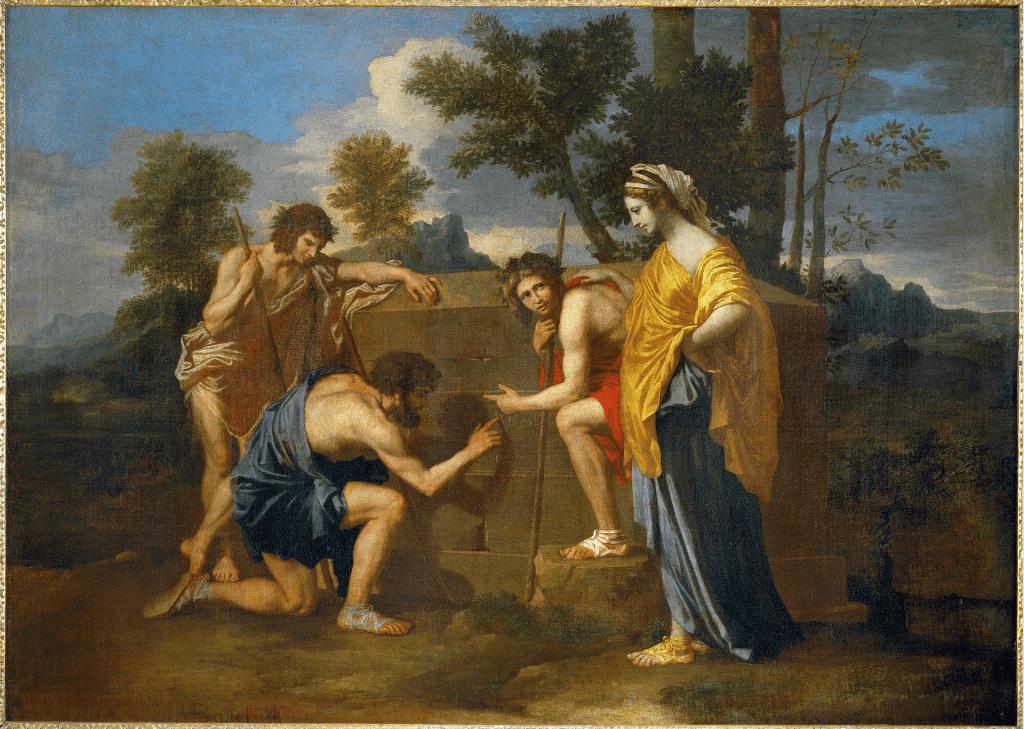
Este cuadro maravilloso, «Et in Arcadia Ego: Les Bergers d’Arcadie,» del artista del barroco francés (tardío), Nicolas Poussin, (Normandía, 1594- Roma 1665), pintado circa 1630 y pico, que está en el museo de Louvre, en París, no solo muestra su maestría, técnica y conocimientos artísticos, pero guarda ciertos misterios debido a esa extraña frase inscrita en la tumba: «Et in Arcadia ego.»
La frase latina significa «Hasta en Arcadia estoy». Arcadia se refiere a lo idílico, a lo pastoral y también a una provincia griega de la antigüedad en el peloponesio, supuestamente el habitat de Pan, el dios de los bosques y las ninfas. Se ha especulado que intenta proclamar que hasta en Arcadia está, aunque agazapada, la muerte. Esto según Giovan Pietro Bellori, biógrafo de Poussin, que dijo que el «ego» era la muerte y que la muerte vagaba hasta por lugares utópicos como Arcadia.
Quizá la frase se refiere al que ocupa la tumba. O quizá Poussin, sin tratar de avisar la inevitabilidad de la muerte, quiso solo rememorar, haciéndole, con la frase y con la tumba, un guiño a la nostalgia. Quien sabe, pero los autores del libro «The Holy Blood and the Holy Grail» de1982, pensaron que Poussin era un miembro de la sociedad secreta Prioridad de Sion y que este cuadro guardaba grandes secretos esotéricos. Pero no dijeron mas.
A mi no se me ocurre nada sobre este supuesto misterio. Pero si lei que en un vallecillo, de la tierra de la lengua de las ocas en el sur de Francia, apareció una vez una tumba como la del paisaje de Poussin. Lamentablemente ya no esta por esos Deus lares…
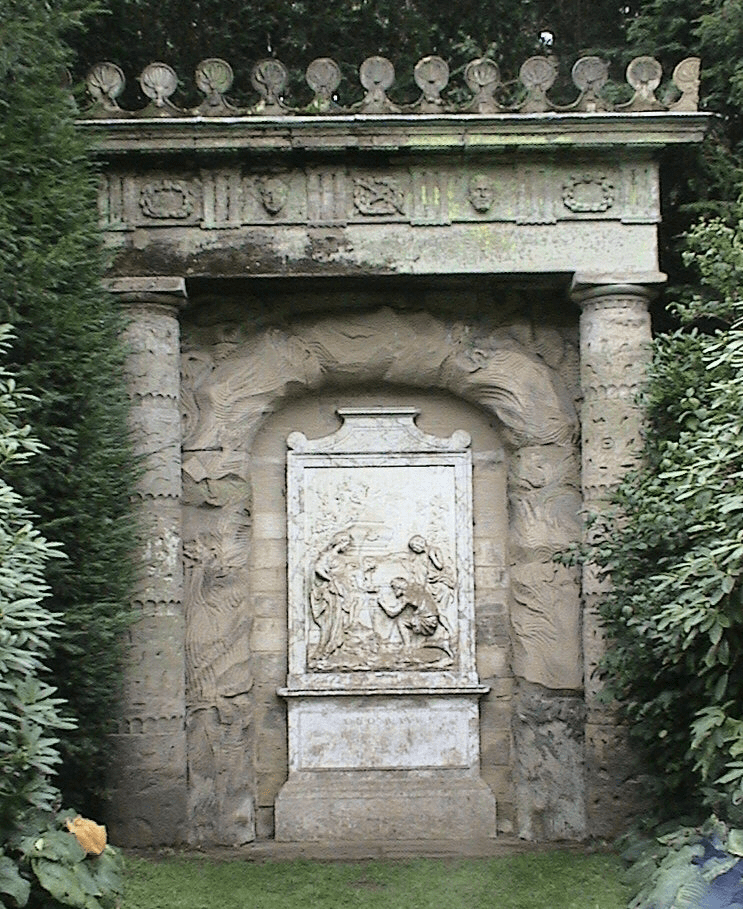
El cuadro de Poussin aparece en el llamado «Monumento a los pastores» (del Siglo XVIII) que está en Shugborough Hall, en la localidad de Staffordshire, Inglaterra. En el monumento vemos la imagen de espejo de la pintura de Poussin pero con algunos elementos agregados. Por ejemplo, encima del sarcófago del cuadro hay otro y debajo hay una piedra con una misteriosa inscripción compuesta de las siguientes letras: O U O S V A V V, esculpidas en la piedra entre las letras D M en un plano inferior. Hasta la fecha nadie ha podido descifrar este enigma, aunque las teorías abundan.
+++
This beautiful masterpiece, «Et in Arcadia Ego: Les Bergers d’Arcadie,» by the French Baroque painter Nicolas Poussin, (Normandy, 1594- Rome 1665), painted circa 1630, hangs in the Louvre museum. It not only demonstrates the artists’ mastery of technique and knowledge of art history, but it seems to hide certain mysteries. One can say that all of it is due to the cryptic inscription on the tomb: «Et in Arcadia ego.»
The Latin phrase can be interpreted as meaning «Even in Arcadia I am.» Arcadia refers to the idyllic, to the pastoral. But it was an ancient Greek province in the Peloponnesus, idealised for its peaceful nature and beloved for its tranquillity. This was the domain of Pan, god of the woods and of the nymphs. It has been speculated that it proclaims that even in such a place as Arcadia, death lurks, perhaps hidden. This became «truth» thanks to Poussin’s biographer Giovan Pietro Bellori, who stated that «ego» referred to death and that death «is» even in utopias like Arcadia.
But it is also possible that the phrase is indicative and pertains to whoever lies in the tomb. Or maybe that Poussin, without intending to warn about the inevitability of death, wanted simply to reminisce, giving such reminiscence a memorable phrase. In other words a nod to nostalgia. I don’t know. However, the authors of the book «The Holy Blood and the Holy Grail» (1982), thought that Poussin was a member of a secret organization called the Priory of Sion, and that this painting held secrets of great esoteric significance. But they do not go beyond that.
I truly wouldn’t even venture a guess. But in a small valley in the land of the language of geese, in the south of France, a lonely tomb like this was found. The same landscape that Poussin painted centuries before. Lamentably it no longer exists in those lands.
Below is the 18th Century «Shepherd’s Monument» in Shugborough Hall, Staffordshire, England. It bears a mirror image of Poussin’s painting, with a few added features. The bas relief has a second sarcophagus placed on top of the one in the painting and beneath a stone bearing the following inscription: O U O S V A V V, between the letters D M beneath them. No one so far has been able to crack what the letters mean. Theories abound…

Gracias…
Cheers…