(From 1888/90/Image source: Wikimedia Commons/licensed under the Creative Commons Attribution-Share Alike 4.0 International license)
Samuel Jessurun de Mesquita (1868–1944) was born in Amsterdam. He was an artist and printmaker. He is known for his intricate etchings, woodcuts, and lithographs that often featured animals, botanical forms, and fantastical or symbolic imagery. De Mesquita was a Sephardic Jew who was largely self-taught. But he became a prominent figure in Dutch graphic art during the early 20th century. He was a bold and visionary printmaker from whom Escher learned much.
His work is influenced by Art Nouveau and Symbolism, and his prints often explore themes of nature, mortality, and mysticism. He taught at the Rijksnormaalschool voor Teekenonderwijzers (a teacher training school for drawing), where one of his most famous students was M.C. Escher, who credited de Mesquita as a major influence on his artistic development.
Samuel Jessurun de Mesquita were murdered by the Nazis in the Auschwitz concentration camp in 1944. After the war, Escher and others helped preserve and promote de Mesquita’s artistic legacy. Today, he is recognized as a master printmaker whose work bridges naturalism and the fantastical, and whose influence extends well beyond his lifetime.
(Image source: Instagram of ngadc)
The above image «Evil Speaking Little Women» contains the Nazi boot print. Escher saved this etching, along with many of his teacher’s works, from the hands of the Nazi destructors.
(Image source El Mundo/La pintora y poeta Carmen Mondragón, mejor conocida como ‘Nahui Olin’. INBA
Lo primero que os dire es que no la conocía y me alegro mucho de que conocimiento de ella me haya llegado. Por supuesto que en la facultad jamás me hablaron de ella, pero Nahui Olin fue un autentico fenómeno en las artes mexicanas. Fue la mujer que liberó a las mujeres artistas…de las antiguas moralidades…de su país. Nahui Olin, fue una verdadera feminista ademas de una revolucionaria. Y lo de ella fue autentico y artistico, no como la otra que siempre mencionan, digamos, Frida Kahlo. Pues a la Kahlo la conocéis, no por ser artista, ni mucho menos por feminista, sino por el merchandising que se ha creado con su nombre y su imagen… Se llamaba María del Carmen Mondragón Valseca y nació en México el 8 de julio de 1893. Fue poeta, pintora y modelo… Quizá la influencia de la escritora inglesa Mary Wollstonecraft la acerco al feminismo y ya que se representaba a si misma en sus pinturas podemos deducir que conocía bien el movimiento feminista mexicano y anglosajón. Estos resultaron en valiosas referencias y un gran empujón a su creatividad… A sus cuatro años de edad su familia se traslado a Francia donde vivieron ocho años y allá fue donde la joven Carmen estudio artes, danza, canto, pintura y teatro… En 1922, durante su relación con el artista plástico Gerardo Murillo, conocido como Doctor Atl, ella toma el nombre de Nahui Olin, que significa cuatro movimiento o perpetuo movimiento en náhuatl. También esta fue su etapa más prolífica de su producción poética y pictórica. Se fue así apartándose de su vida acomodada y comenzó a relacionarse cada vez más con su raíces indígenas… Su obra pictórica es Naif, y muchos de sus cuadros son autorretratos y también muchos que se caracterizan por ser eróticos y en donde explora su sexualidad… Su obra poética se caracteriza por sus temas concernientes a la libertad corporal de las mujeres, cosa revolucionaria para su época…. Nahi Olin murió en su ciudad natal en 1978.
+++
The first thing I’ll tell you is that I did not know her, and I am very glad that I have come to know about her. Of course at Uni no one ever spoke to me about her, but Nahui Olin was a true phenomenon in Mexican arts. She was the woman who liberated female artists… from the old moralities… of her country. Nahui Olin was a true feminist as well as a revolutionary. What she created was authentic and artistic, unlike the other artist that is always mentioned, let’s say, Frida Kahlo. You know Kahlo, not as an artist, nor certainly as a feminist, but for the merchandising created around her name and image… Her name was María del Carmen Mondragón Valseca, and she was born in Mexico on July 8, 1893. She was a poet, painter, and model… Perhaps the influence of the English writer Mary Wollstonecraft brought her closer to feminism, and since she represented herself in her paintings, we can deduce that she was well-acquainted with both the Mexican and Anglo-Saxon feminist movements. These experiences provided valuable references and a great boost to her creativity… At the age of four, her family moved to France, where they lived for eight years, and it was there that young Carmen studied arts, dance, singing, painting, and theater… In 1922, during her relationship with the plastic artist Gerardo Murillo, known as Doctor Atl, she adopted the name Nahui Olin, which means “four movement” or “perpetual movement” in Nahuatl. This was also her most prolific stage for poetic and pictorial production. Thus, she distanced herself from her comfortable life and began to relate more with her indigenous roots… Her pictorial work is Naif, and many of her paintings are self-portraits, as well as others characterized by their eroticism, where she explores her sexuality… Her poetic work is marked by themes concerning women’s bodily freedom, which was revolutionary for her time… Nahui Olin died in her hometown in 1978.
I must admit that until quite recently, when I ran across an article about her, I had never heard of Lucia Wilcox. But seeing that she had been an influential painter, especially for the surrealism movement, I could not leave her behind. However, there is not much about her to be found.
For starters she was born in Beirut, Lebanon in 1902 (although some say 1899). She moved to Paris as a young woman and there met Picasso, Léger and other young aspiring artists. She wanted to study art and possibly did at the Académie Ranson. André Derain, a fauvist, became her mentor.
In 1938, with war on Europe’s horizon Wilcox left for the United States. She settled in Amagansett, Long Island where she became friends with Jackson Pollock, Frederick Kiesler, Max Ernst, and others. In New York Lucia had her first solos show in 1948 at the Sidney Janis Gallery. Then in 1949 she was instrumental in organizing East Hampton’s first contemporary art exhibit at Guild Hall. Reviews of her artwork from TheNew York Times and other newspapers, described her work as being “a dramatic compound of Byzantine color, allegro fancy, modern treatment, and near mystic feeling.”
Her work was mostly surrealist up until the 1950’s when she started doing some abstract expressionism, something quite popular at that time. Lucia was invited to participate in two of the four historic exhibitions that Alfonso Ossorio organised at Signa Gallery in 1957 and 1959. Then in 1961, she had a solo exhibition at Lefebre Gallery on East 77th Street in Manhattan.
By 1972 she had gone blind but continued to work, substituting ink for oils and allowing her mind to guide her, free of distractions. Lucia Wilcox died in New York in 1974.
These are some of her works. I find them interesting. What about you?
(«Pathway to the Clouds/1946/Image source: Berry Campbell Gallery)
Photo: Oscar White/Corbis/VCG via Getty Images/Image source: Biography)
You would think that the painter of «silence» was a subdued, quiet and laid-back sort of chap, but he wasn’t…
He was born in Nyack, New York in 1882 in a well off upper middle class family. From the age of 5 he was taught to pursue artistic paths. When he decided he wanted to be an artist he was placed in the New York School of Art and Design. He graduated in 1905 and started to work as an illustrator for an advertising agency. He went to Europe, first to Paris, several times in 1906, 1909 and 1910. In 1910 he also visited Spain.
Although Paris in those years was filled with innovative, creative and experimental artists, such as Picasso, Braque, Matisse and others, Hopper did not seem the least bit interested. He shunned the art vanguards of the 20th Century, such as abstract art, fauvism and cubism, that were being developed and in vogue. Instead he was most impressed and interested in the works of the impressionists, especially Claude Monet and Edouard Manet. He learned well from their use of light.
In 1910, having returned to the United States, Hopper began exhibiting his works. At this time he moved to an apartment in Washington Square where he lived and worked most of his life. He married Josephine Nivison in 1924. She was rather a successful painter and often worked together. But their life was no pleasure cruise. Both were dominating and jealous people. Josephine demanded that she be the only female model for any future paintings featuring women. And he also tried to control her. And with her being the successful artist, that made things quite interesting.
In any event it is quite well known that their marriage was totally dysfunctional. Yet, thanks to Josephine, Hopper’s art career began to bloom and finally take off. Her art connections led to Hopper having a one-man exhibition at the Rehn Gallery. There he sold all his watercolours. From time time on Hopper’s association with the Rehn Gallery became life-long.
Edward Hopper is one of the best known US artists. His work was a profound study of American life in the which he emphasised its isolation and contemplation. He is, most certainly, a very important artist in the history of art. Hopper died of natural causes in his studio on the 15th of May 1967 in his Washington Square Park studio in Manhattan.
El atelier es el sanctum sanctorum de los artistas, o de muchos artistas, diría yo. Hay tantas variedades como artistas. Algunos mantienen sus estudios limpios y bien organizados. Otros son un chiquero, desordenados, sucios, totalmente una locura. Algunos artistas alquilan estudios lejos de sus hogares, algunos pintan en casa en un área o habitación separada utilizada como estudio. Pero ha habido otros que han pintado en el salón de su casa, sobre una alfombra cara y vestidos con chaqueta de esmoquin, diciéndole al mundo que la pintura pertenece al lienzo y no al suelo. ¿Puedes adivinar quién era ese artista*?
Bueno, hagamos un breve recorrido por los ateliers de algunos de los artistas más famosos en la Historia del Arte y veamos el entorno en el que se encontraban cuando creaban.
+++++++++++++++++++++++
The studio is the holy of holies for many artists. There are as many varieties as there are artists. Some studios are clean and well organised. Others are a pig-pen, messy, dirty, totally in disarray. Some artists rent studios away from their homes, some paint in the home in a separate area or room used as a studio. But there have been others who have painted in their home’s salon, on an expensive rug and dressed in smoking jacket and telling the world that he does not create stains, because paint belongs on the canvas and not on the floor. Can you guess who that artist* was?
Well, let’s take a short tour through the studios of some of the most famous artists in Art History and see the environment they were in when they created.
(Photos are taken from the public domain and rights are retained by their respective authors)
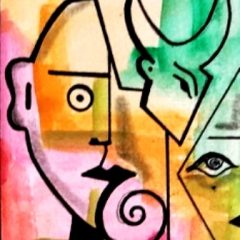
(«El Toro de Bodo ’04″/Francisco Bravo Cabrera/All Rights Reserved)
ART AND THE ARTIST
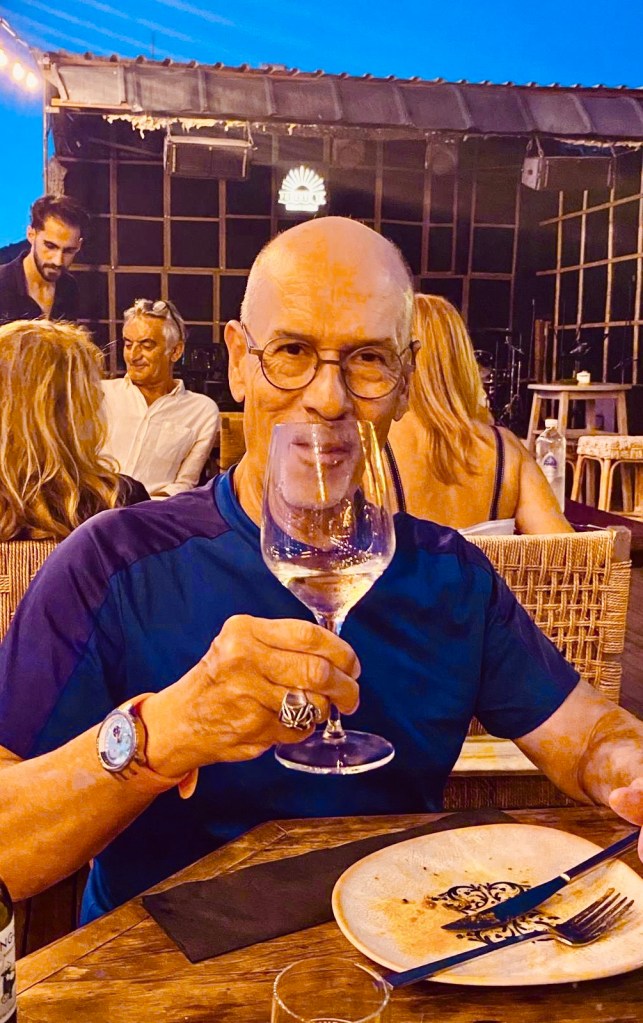
(Francisco Bravo Cabrera, while listening to the Sonata no. 9 by Beethoven)
Well, maybe I should rather say ART AND LIFE or THE ARTIST AND LIFE, something like that, I don’t know, I think it may have been a better title, but no, the one I’ve chosen I like…
Life, what is life? José Saramago in his book All the Names said: “Life is like paintings; it’s best to look at them four steps back.” Four steps… phenomenal.
The distinguished writer, whom I admire very much, has told us what life is similar to, but he has not told us what life actually is, nor why he relates it to paintings. Well, could it be that paintings are similar to life? I don’t think so, but anything is possible.
Paintings are representations. Nothing that is portrayed on the canvas, wood, or whatever surface the painter uses is truth. Moreover, I remind you that nothing in art is reality. The closest it comes is to a reflection, if the artist does it well, and if you immerse yourself in the painting, you may see something in it that you associate with real life. But you won’t find reality in any painting. However, if you’re lucky, you’ll see how the author has perceived it. A painting, like a movie, a play, or a ballet, lies. Finally, don’t delude yourself into thinking that you’ll find sincerity in art. Perhaps art is the most cynical thing on the face of the earth. Don’t doubt it.
And why do I tell you this? Because I am an artist. My professional and academic training taught me that reality is not art. Art feeds on reality, uses it, embellishes or tarnishes it, but always changes it. The actor does not feel what you think he is feeling when you see him in the theater or in a movie. Neither does the painter nor the poet. Yes, we all play with emotions, but as the great director and co-founder of the Moscow Art Theatre, Konstantin Stanislavski, said, “Raw emotion (human) is not art.” We play with real emotions, but the ones we represent are artistic creations, period.
So, why take four steps back? Frankly, I don’t know. Looking for a better perspective? Maybe…
But well, let’s see, what is an artist? The great masters of the European Renaissance did not consider themselves artists. They viewed themselves as craftsmen, men (and women) who had learned their trade well and had also been trained in other disciplines. Moreover, they painted not what they wanted, but what was commissioned by their great patrons, who were the church, royalty, nobility, and to some extent, the emerging bourgeois class.
It may have been Michelangelo who first considered himself an artist, but that’s debatable. The thing is that artisans and craftsmen began to turn into artists. Once they were artists, they could choose the themes they were going to paint, and the subject matter shifted from biblical scenes and portraits of kings to something more casual, everyday, and completely secular. Art began to gain value, and collectors emerged. Then came the museums, and with them, art history started to be written. In 1793, the Louvre Museum was founded in Paris, the Prado Museum opened its doors in Madrid in 1819, and the Metropolitan Museum of Art in New York in 1870.
That’s how things began to change. The avant-gardes of the 20th century came along, and art took on previously unthinkable directions, causing artists to evolve. But now, after the great artistic milestones of geniuses like Picasso and Matisse, artists no longer know what to do. They seek to experiment, draw attention, shock, alarm, scandalize, and even offend. They also enjoy making people think they are exceptional beings with almost supernatural abilities. But don’t you dare believe that; it’s all nonsense.
Artists today are neither geniuses nor avant-garde. Everything has already been done, so don’t think that for art to be good it has to be original because nothing is original anymore in art. A good artist, as Picasso said, imitates, but a brilliant artist steals. However, what they have stolen is transformed into something better. And I remind you that we create art for only one reason: to earn a living. Nobody enters a studio for ten hours a day, painting like a madman, for the love of art. We do it because we want to sell our work. And if they talk to you about inspiration, don’t believe it either. It’s a myth, nonsense, a fairy tale, a con trick. The artist works and dedicates themselves to their craft not because a muse with magical powers has inspired them, but because they are hungry.
Perhaps a better title would have been The Great Deception…
(«La cena de Dalí»/Francisco Bravo Cabrera/All Rights Reserved)
It is said that Dalí and Gala once found a little bunny rabbit and they kept it as a pet. But since they usually, come November, left to spend the winters in the United States, they did not know what to do with their furry little pet. So, Gala called their cook and said to him, «tomorrow we have stuffed rabbit». The poor cook had to comply and with sadness in his heart and tears in his eyes, he cooked the rabbit. His tears rolled down his cheeks as he served Dalí and Gala the meat of what had been their beloved little pet.
And, to be able to create (see below) «Dalí Atomicus«. This 1948 photograph by Phillipe Halsman required 26 attempts, where they threw three cats and water into the air. How little regard for these poor animals they both showed.
A final anecdote is that Dalí often organised bullfights, and in one of them, he took and filled a dummy bull with live cats and bags filled with fish into the round and with some pyrotechnic devise blew it up so that the live animals inside would fly through the air landing on the spectators. Of course all of this was «surrealistic» and created by the self-named «genius» of modern art.
So, if you want to know why I have such a strong distaste for this non-genius, well here are some of them…