#art, A Word on Jazz and Art

(JaZzArT/Francisco Bravo Cabrera/Derechos Reservados/All Rights Reserved)

Jazz was invented at the turn of the XX Century in New Orleans. It immediately spread, confusing itself at times with the blues, with ragtime, with Dixieland. Later it was merged into rock by such greats as Jaco Pastorius, Weather Report, and even…I dare say…early rockers like Jimi Hendrix, Jimmy Page and Eric Clapton. The group Traffic also was greatly influenced by jazz and the solos created by these artists show tremendous knowledge of harmony and improvisation, both essential elements of jazz.

But can jazz, in other words the music created by improvisation, the player as composer and swing (rhythm), be applied to other arts. Surely it can be applied to dance and choreography, but what about painting? I say yes! Absolutely! A painting has to define itself, no matter how well planned and sketched it has been by the artist. The canvas, the composition, has to create itself, and there must be room of improvisation and of course, the composition must swing, it must have dynamics and that is akin to rhythm…

Of course it also helps if the composition represents elements of music or musicians. My series of JaZzArT is created by illustrating fictional (or not) jazz groups that I have imagined (or seen). They try to capture the moment onstage when there is a pause in the music and the players breathe…

+

+++

(2021/Please do not forget to like)

CHEERS

Poem: “FENESTRA”

(Foto propiedad de FBC, Omnia Caelum Studios València, Derechos Reservados)

Si pudiera un día volar,

saldría volando sonriente,

complacido,

reluciente.

Alucinados, dementes,

por la ventana esa gente saldría volando también,

y en los vientos saludarnos,

en los aires encontrarnos,

volando libre con fe.

C.2021, Francisco Bravo Cabrera, 30 de diciembre 2021, València, España 🇪🇸

Hoy deseándoos unas felices fiestas, especialmente la natividad de nuestro Senor Jesus. Que compartáis con quienes queréis estar y que la paseis feliz y bendecidos. Un fuerte abrazo de nosotros los de Omnia Caelum Studios Valencia.

MUCHAS GRACIAS

We are Omnia Caelum Studios València

(Image is a detail from a painting by Francisco Bravo Cabrera/All Rights Reserved)

We are colour, figure, and abstraction…

Instagram: @Francisco_Bravo_Cabrera

YouTube: @FranciscoBravoCabrera

CHEERS

Art at Omnia Caelum Studios València

(FBC/OCS València/Derechos Reservados)

We are colour, movement and intention and we believe in art as a medium but also as happiness…

CHEERS

#art, «Art and the Artist»

(«El Toro de Bodo ’04″/Francisco Bravo Cabrera/All Rights Reserved)

ART AND THE ARTIST

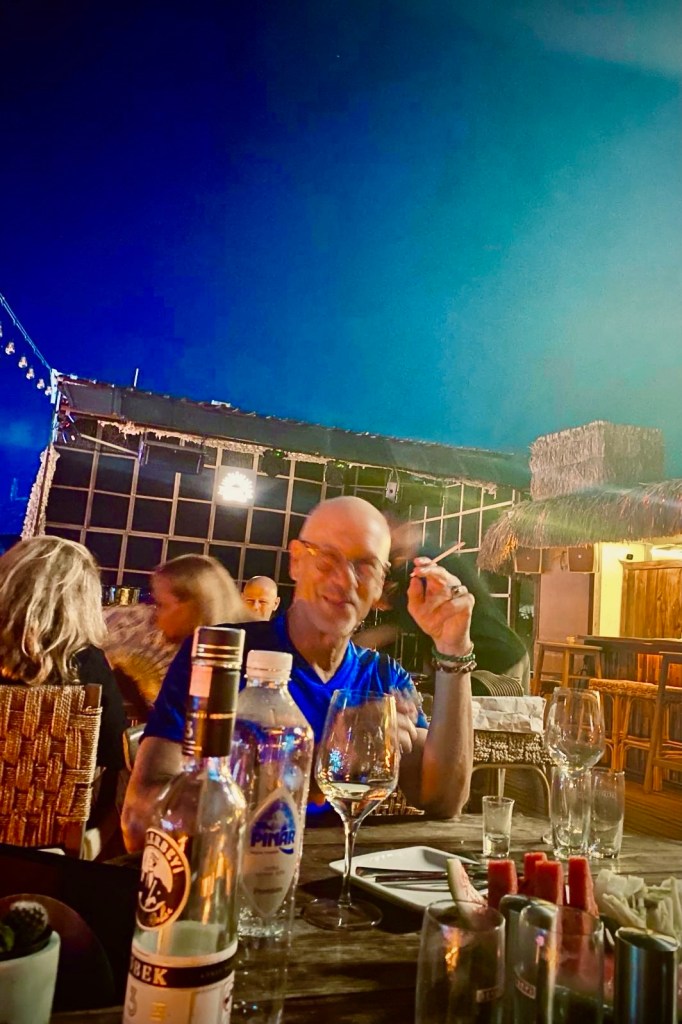
(Francisco Bravo Cabrera, while listening to the Sonata no. 9 by Beethoven)

Well, maybe I should rather say ART AND LIFE or THE ARTIST AND LIFE, something like that, I don’t know, I think it may have been a better title, but no, the one I’ve chosen I like…

Life, what is life? José Saramago in his book All the Names said: “Life is like paintings; it’s best to look at them four steps back.” Four steps… phenomenal.

The distinguished writer, whom I admire very much, has told us what life is similar to, but he has not told us what life actually is, nor why he relates it to paintings. Well, could it be that paintings are similar to life? I don’t think so, but anything is possible.

Paintings are representations. Nothing that is portrayed on the canvas, wood, or whatever surface the painter uses is truth. Moreover, I remind you that nothing in art is reality. The closest it comes is to a reflection, if the artist does it well, and if you immerse yourself in the painting, you may see something in it that you associate with real life. But you won’t find reality in any painting. However, if you’re lucky, you’ll see how the author has perceived it. A painting, like a movie, a play, or a ballet, lies. Finally, don’t delude yourself into thinking that you’ll find sincerity in art. Perhaps art is the most cynical thing on the face of the earth. Don’t doubt it.

And why do I tell you this? Because I am an artist. My professional and academic training taught me that reality is not art. Art feeds on reality, uses it, embellishes or tarnishes it, but always changes it. The actor does not feel what you think he is feeling when you see him in the theater or in a movie. Neither does the painter nor the poet. Yes, we all play with emotions, but as the great director and co-founder of the Moscow Art Theatre, Konstantin Stanislavski, said, “Raw emotion (human) is not art.” We play with real emotions, but the ones we represent are artistic creations, period.

So, why take four steps back? Frankly, I don’t know. Looking for a better perspective? Maybe…

But well, let’s see, what is an artist? The great masters of the European Renaissance did not consider themselves artists. They viewed themselves as craftsmen, men (and women) who had learned their trade well and had also been trained in other disciplines. Moreover, they painted not what they wanted, but what was commissioned by their great patrons, who were the church, royalty, nobility, and to some extent, the emerging bourgeois class.

It may have been Michelangelo who first considered himself an artist, but that’s debatable. The thing is that artisans and craftsmen began to turn into artists. Once they were artists, they could choose the themes they were going to paint, and the subject matter shifted from biblical scenes and portraits of kings to something more casual, everyday, and completely secular. Art began to gain value, and collectors emerged. Then came the museums, and with them, art history started to be written. In 1793, the Louvre Museum was founded in Paris, the Prado Museum opened its doors in Madrid in 1819, and the Metropolitan Museum of Art in New York in 1870.

That’s how things began to change. The avant-gardes of the 20th century came along, and art took on previously unthinkable directions, causing artists to evolve. But now, after the great artistic milestones of geniuses like Picasso and Matisse, artists no longer know what to do. They seek to experiment, draw attention, shock, alarm, scandalize, and even offend. They also enjoy making people think they are exceptional beings with almost supernatural abilities. But don’t you dare believe that; it’s all nonsense.

Artists today are neither geniuses nor avant-garde. Everything has already been done, so don’t think that for art to be good it has to be original because nothing is original anymore in art. A good artist, as Picasso said, imitates, but a brilliant artist steals. However, what they have stolen is transformed into something better. And I remind you that we create art for only one reason: to earn a living. Nobody enters a studio for ten hours a day, painting like a madman, for the love of art. We do it because we want to sell our work. And if they talk to you about inspiration, don’t believe it either. It’s a myth, nonsense, a fairy tale, a con trick. The artist works and dedicates themselves to their craft not because a muse with magical powers has inspired them, but because they are hungry.

Perhaps a better title would have been The Great Deception

Mysteries Abound, but Experts… (good grief experts!)

(Image from Facebook/William Doubleday/Image source: Texas Hill Country)*

There are things on earth that completely contradict the «official» history as recorded and supported by so-called «experts» (good grief experts!). It is well known that there are many other sites older than the pyramids of Giza, like Göbekli Tepe in what is now Türkiye. There are other sites discovered, and being discovered, with monuments, art and clear evidence of an advanced culture all over the world. But «experts» choose to deny their existence or say that what people are calling a structure or a temple is a natural formation. And how do they know this? Well, they are experts…

These «experts» say that they pyramid complex of Giza is approximately 2.600 years old. How the hell did they come to that conclusion when many others that have studied the complex, along with comparative studies of the region say that the pyramids could be three or four time older? Well, they are «experts» and they do not like to be contradicted.

The Texas rock wall, in the town of Rockwall, Texas, is another example of evidence of an advanced culture perhaps 10-15.000 years old that the so-called experts are saying that it is nothing more than a natural formation. The wall, found buried, is over 7 stories tall (21 metres) and as long as 20 miles (32,19 Km). Areas of the wall show what might have been windows and in some areas there were actual rooms found. But, because it does not fit into their narrative…which they refuse to change/amend…the geologists and other «experts» say that it is only a natural formation. Nothing to get hung about…

Well, we know that every time there is something strange seen, whether in the sea, the sky or the land, and we do not know what it is, some «expert» says that there is rational, logical and scientific explanation for it. In my mind those are key words that mean «we are the experts and we will lie to you» and that way they can continue with their «scientifically» accepted theories without letting the «facts» get in the way. The strange cloud we saw coming into the shores of Portugal early in July comes to mind. Although it looked to all as something «otherworldly» the experts quickly said that it was only a type of cumulous cloud that rolls on itself and looks strange. Hmm…

And of course we have the Art experts deciding what is authentic and what is fake. They tell us that a painting someone found in a rubbish bin in Weehawken (NJ) is really a lost masterpiece. And that a painting, such as the «Salvator Mundi» was really painted by Leonardo, because it looks like something he would have painted. Well, there were many artists in Leo’s day that painted just as good and very similarly. Leonardo was one of many, not an exception. Of course, except to the experts.

So I’ve no use for such «experts», neither in art or in science. The real scientists, the ones that have the knowledge, the academic titles and the track record, are men and women with open minds, as all investigators should be. They do not go around making assertions on things that they do not understand. And what they do work on are things for the benefit of our health care and life in general. For me to believe an «expert» he has to show me how he got to the level of supposed expertise. Otherwise, to me, he is just one more charlatan out there selling snake oil…

* The image is of a portion of the Texas rock wall

Now it is your turn, tell me what you think…

CHEERS

Bon dia!

¿No os parece que eso es lo que está pasando, ha estado pasando y seguirá pasando?

#art, Alma Buscher in the Women Artists Series 2025

(Photo El Mundo)

Alma Buscher was a German designer who studied and trained at the Bauhaus… She was born in Kreutzal, Germany in 1899… In 1922 she began her studies at the Bauhaus of Weimar taking Johannes Itten’s preliminary class and later classes offered by Paul Klee and Wassily Kandinsky. She was accepted to the textile workshop directed by Georg Muche, but later, in 1923 she changed to wood sculpture under the direction of Josef Hartwig. That same year she exhibited her furniture designs at the first Bauhaus exhibition. Her items were children’s furniture, theatrical puppets and marionettes and other toys.

Alma Buscher died died during a bombing raid (WWII) in Buchschlag, close to Frankfurt on the 25th of September of 1944. Short life, not enough work done but I think she showed a tremendous potential and who knows how far she could have reached had she survived the Second World War.

(Image source: Design Graduate)
(Image source: Casa Museo)
(Image source: Arquiscopio)

CHEERS