(Image property of Francisco Bravo Cabrera/All Rights Reserved)
«Let the Sun Shine In» (canvas version) available only through my gallery at Fine Art America. Fine Art America reproduces and offers my images as high quality prints, which is an affordable way to own original art, and they handle the entire transaction and ship promptly once the order is ready.
«The Windmills of Your Mind» has always been one of my favourite songs of all time. I don’t know why, perhaps because of its very mystical, intriguing and psychological lyrics paired with a phenomenal musical accompaniment. The song is mysterious and every time I hear «The Windmills of Your Mind» it brings different memories to my mind. The latest memories were of going to see Tom Jones last year in Valencia and he sang it…
I will leave you the lyrics here so that you can sing along…
[Verse 1] Round like a circle in a spiral, like a wheel within a wheel Never ending or beginning on an ever-spinning reel Like a snowball down a mountain or a carnival balloon Like a carousel that’s turning, running rings around the moon Like a clock whose hands are sweeping past the minutes of its face And the world is like an apple whirling silently in space Like the circles that you find in the windmills of your mind
[Verse 2] Like a tunnel that you follow to a tunnel of its own Down a hollow to a cavern where the sun has never shone Like a door that keeps revolving in a half forgotten dream Or the ripples from a pebble someone tosses in a stream Like a clock whose hands are sweeping past the minutes of its face And the world is like an apple whirling silently in space Like the circles that you find in the windmills of your mind
[Verse 3] Keys that jingle in your pocket, words that jangle in your head Why did summer go so quickly? Was it something that you said? Lovers walk along a shore and leave their footprints in the sand Is the sound of distant drumming just the fingers of your hand? Pictures hanging in a hallway or the fragment of a song Half remembered names and faces, but to whom do they belong? When you knew that it was over, you were suddenly aware That the autumn leaves were turning to the colour of her hair.
(This is the Noel Harrison version from the 1968 film The Crown Affair)
«The Windmills of Your Mind» was written by Michel Legrand. The lyrics written by American lyricists Alan and Marilyn Bergman. The French lyrics, under the title «Les Moulins de mon cœur«, were written by Eddy Marnay. The song was originally recorded by the English actor Noel Harrison in 1968. Legrand wrote a long Baroque melody and Alan and Marilyn Bergman added the stream of consciousness lyrics. The result was magic.
There are many versions of this song since the Noel Harrison version, which Andy Williams passed up. Then you have the Dusty Springfield version, a version by Sting, José Feliciano, Johnny Mathis, Barbara Streisand, Sinne EEg, Mel Tormé, and my personal favourite by Tom Jones…
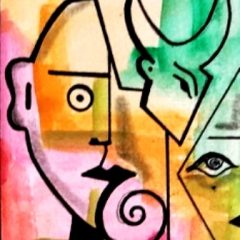
(«Alejandra»/Francisco Bravo Cabrera/All Rights Reserved)
Art is the search, and it has to be because without the search nothing can be found. Change your mind, change the world, change everything. Being static, intransigent and stubborn only leads to stagnation. Change leads to recognising that the search is art.
(We kindly ask you to please like, comment, share and subscribe as this helps our channel)
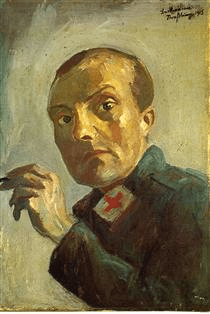
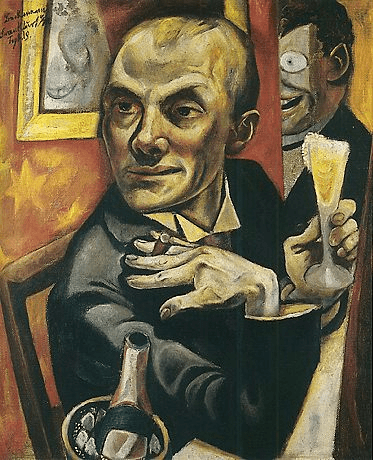
(Self-portrait as Nurse/1915/Image source: Wikiart)
Max Beckmann: Life and Work of a German Expressionist
Max Beckmann, born in Leipzig, (1884–1950), was a painter, draftsman, printmaker, and writer whose work bridged the movements of Expressionism, New Objectivity, and Symbolism. Known for his bold use of color, dramatic compositions, and psychological depth, Beckmann’s art reflects the turbulence of the 20th century, especially the social and political upheavals of Germany in the aftermath of two world wars.
Beckmann studied at the Weimar Academy of Arts. His early works were influenced by German Impressionism, but the horrors of war led him to develop a darker, more symbolic style that distanced him from mainstream Expressionism, even as critics continued to associate him with the movement.
During the 1920s, Beckmann became a central figure in the Neue Sachlichkeit (New Objectivity) movement, which aimed to depict the world with unsentimental realism. His paintings from this period often portray the alienation and decadence of Weimar society, with complex compositions populated by enigmatic figures and theatrical settings.
The Nazis branded him as a “degenerate artist”. In 1937 he was dismissed from his teaching post and had his work removed from German museums. He fled to Amsterdam and later emigrated to the United States (1947), where he taught at institutions such as Washington University in St. Louis and continued to paint until his death.
Throughout his career, Beckmann created a significant body of work, including over 100 self-portraits, which served as intense meditations on identity and the role of the artist in society. His use of triptych formats, reminiscent of medieval altarpieces, elevated his themes to a metaphysical level, confronting issues of suffering, fate, and redemption.
Max Beckmann died in 1950 in New York City. His legacy remains vital to modern art, as his unflinching vision and symbolic complexity continue to resonate with audiences today.
+++
(Self-Portrait/Image source: Historia Arte)
(Portrait of the Family Lutjens/Image source: Museum Boijmans van Beuningen)
(Birth/1937/Image source: Historia Arte)
(Max Beckman/Image source: AD Magazin)
(We kindly ask you to please like, comment, share and subscribe as this helps our channel)
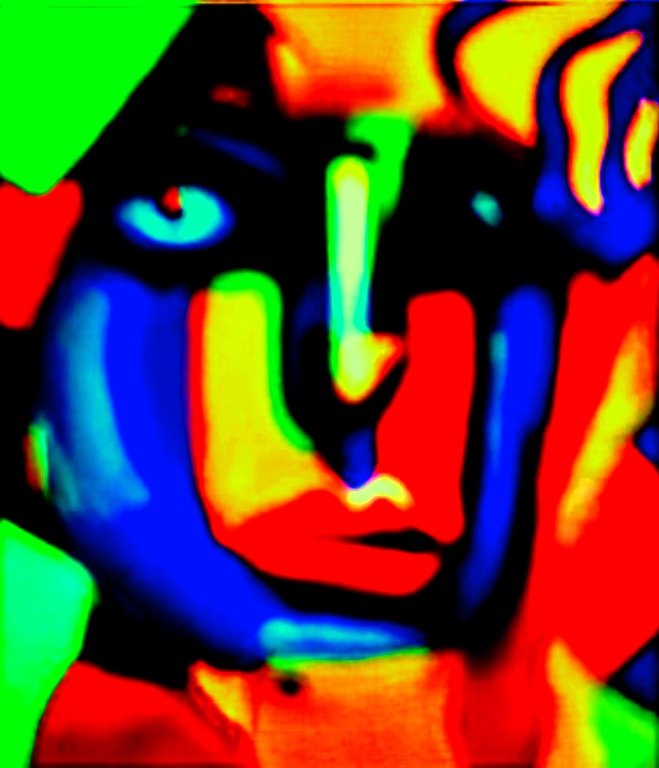
(«The Shadow of an Expression»/Surreal-Expressionism by Francisco Bravo Cabrera/All Rights Reserved)
YOUR SHADOW
Stay strong always, brave, daring. Who shall you fear? March on even when weary life will give you no reprieve, you must defy her with every turn…
Your shadow is not your rival, it is your guide… Your steps will pave the road, and though it may be twisted, with each stride you find it straight.
See the road through gentle eyes. Your shadow never leaves you; watch closely as it smiles, and with a wink it beckons you toward the tavern where you’ll find good wine, potato omelette, pork sausage, Iberian ham, blood sausage, it’s a true delight.
Your shadow never betrays you, listen to its counsel for it knows more than what was drummed into you by the donkeys of the academy, in their foul chambers where indecency gleams.
They may use you like a rag, but your shadow, foolish human, cannot be deceived, not for one moment.
Francisco Bravo Cabrera / August 12/22, 2025 / Izmir, Türkiye
(«Ghostly Faces on the Wall»/Francisco Bravo Cabrera/All Rights Reserved)
“Changing of the Guard” (An Euro-Ku)
These city streets recall my passing and remember my footsteps, on each corner and pass from mouth to mouth stories I had quite forgotten, while faces in the winds blur like smoke, but the echoes of their voices always linger.
I pass greeting the shadows of old promises, my hands reaching for what I had lost, like a crown of fleeting triumphs that precariously balanced on my head.
Moonlight permeates the darkened wall, and the changing of the guard, unseen by only me, leaves behind only the pulse of time.
C.2025 – Francisco Bravo Cabrera – 21 AUG 2025 – Izmir, Türkiye
NOTA BENE
An Euro-Ku is my invention from 2022. As I admire the original Japanese poetry form, I wanted to write in the style. However, being a Westerner and not having the benefit of the Japanese culture, language or history, I felt I could not honour the original Haiku. So I thought it would be beneficial to create a similar form but suited to the European mentality, history and culture. The Euro-Ku still maintains the three stanzas or verses, however, since it is written in English, (or any other European language), it made no sense to stick to the strict syllabic count, which works for Japanese but not for any other language. So there are no syllabic counts or restrictions in the Euro-Ku. Another rule, if I may, is that the verses must flow easily and logically into each other completing the thought and the story. No verse should just flow into outer space. And finally the Euro-Ku must be accompanied by an original, inedited illustration made by the author specifically for the poem.








 JaZzArt en València