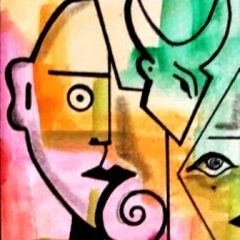
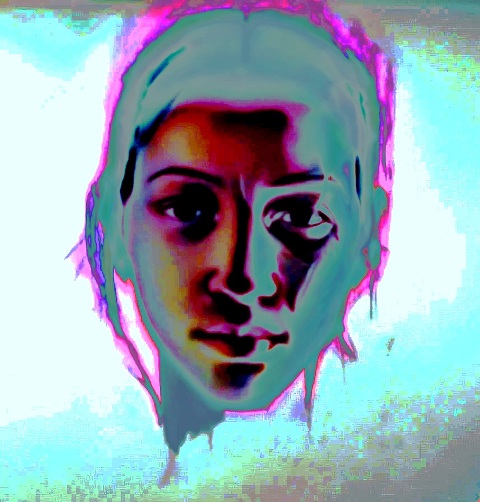
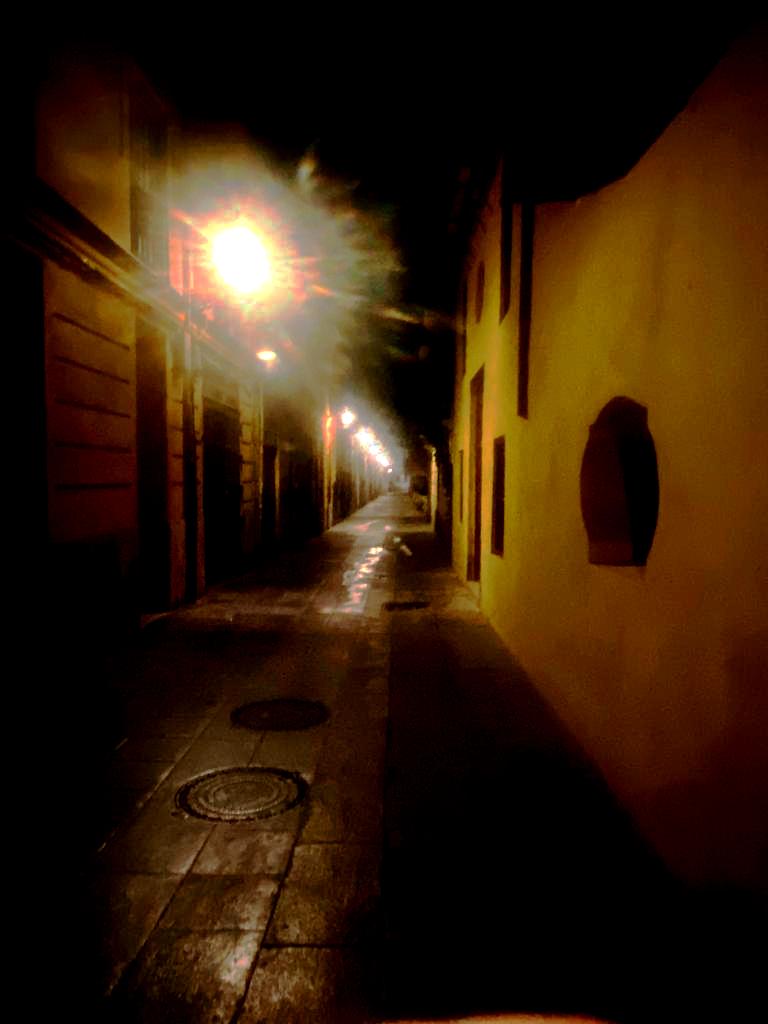
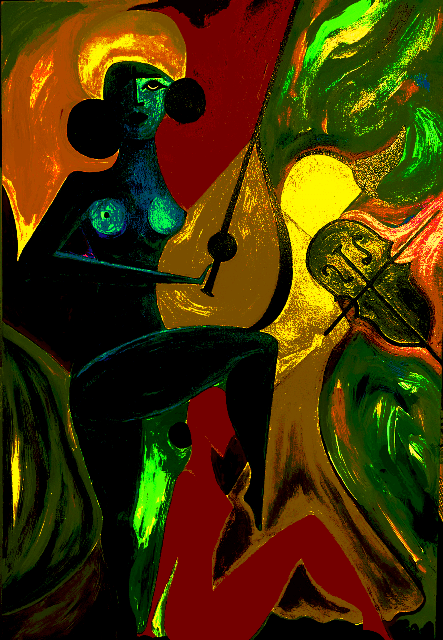
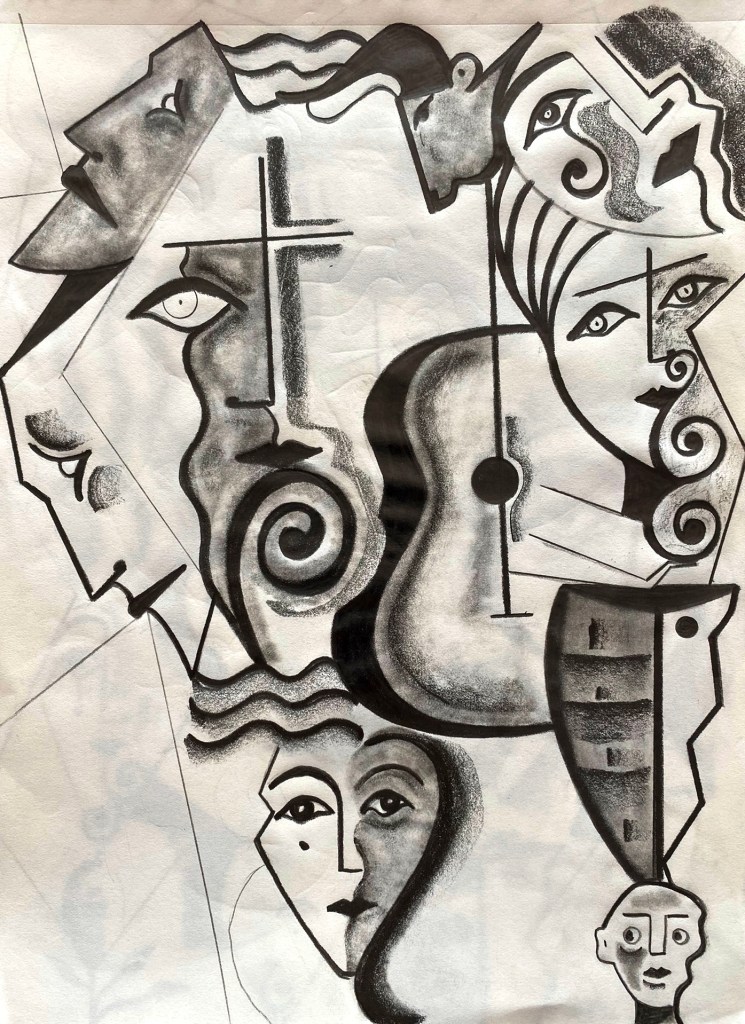
(Original Art by Francisco Bravo Cabrera/All Rights Reserved)
“AUTUMN LIGHT REMEMBERED” (Inspired by Brahms Symphony No. 3, Mvt. III Poco Allegretto)
In the silence sewn between two heartbeats, a violin begins to stir, a gentle softness, as evening’s silken hair brushing over the river’s flowing silence, warm as a name no longer spoken, a name never forgotten.
The melody walks the silver path that lovers do when they fear the world might vanish if they float through here too quickly.
The violins, cellos and violas carry the ache of an autumn’s evening light, amber and trembling, so faint but yet remembering everything it ever held in its soft glow.
Here love whispers love, yet knows of joy’s fragile membranes, and how easily it slips through even the most faithful hands.
Stillness… Settles evenly beneath the sighs of strings, while promises move the pulse of hope threading through the shadows, to tell you: I am with you, even in the places where we cannot remain.
And then the music ends as love oftentimes does, not broken, but evaporated, like darkness on a brilliant morning, leaving ghosts to fill the air with thoughts, creating the final chord that echoes endlessly through the indifference of a sunny day.
C.2025, Francisco Bravo Cabrera, 6th of December 2025, Valencia, España
(«Yayoi» de/by Francisco Bravo Cabrera/Derechos Reservados/All Rights Reserved)
Parece que el negocio del arte sigue prosperando y «artistas» siguen triunfando entre los ricos capitalistas que los ensalzan y los elevan a estas alturas alucinantes…
+++
It seems that the art business continues to thrive, and «artists» continue to succeed among the wealthy capitalists who praise and elevate them to these astonishing heights…
(Foto/Photo La Vanguardia)
Yayoi Kusama (que en mi opinion no es otra que la misma Yoko Ono) ahora la han convertido en una enorme estatua y la muestran decorando un edificio de lunares de colores…
+++
Yayoi Kusama (who in my opinion is none other than Yoko Ono) has now been transformed into a massive statue that adorns a building with colourful polka dots…
(Foto/Photo Sortir à Paris)
La «artista» japonesa ha firmado con la firma Louis Vuitton y esta invierte en una enorme instalación en su tienda en los Champs-Elysées de París donde vemos a Yayoi Kusama poniendo sus lunares de colores en la fachada del inmueble; también en Place Vendôme, donde un «robot» Yayoi está dibujando sus lunares o saber que, continuadamente en una ventana.
+++
The Japanese «artist» has signed with Louis Vuitton who has investedhuge installation in their store on the Champs-Elysées in Paris, where we can see Yayoi Kusama placing her colourful polka dots on the façade of the building. They are also present in Place Vendôme, where a Yayoi «robot» is drawing her polka dots in a continuous manner in a window.
Pues venga, aquí os dejo un vídeo que hice acerca de esta «artista.»
+++
And here is a video for you with my take on this «artist.»
(«Medieval Jazz No. 2″/Francisco Bravo Cabrera/All Rights Reserved)
THE TIMELESS CIRCLE OF MASTERS (of art)
Usually most people think of the great masters of the Renaissance when asked about their favourite artist. Others look more to the recent past or even to the present. But knowledge of art history is very sketchy among most people and even among many artists who have not gained from the vast amount of knowledge that art history contains. So, the solution is to study art history?
Well, yes, but no, not necessarily. You can subscribe to my blog and to my YouTube channel (www.YouTube.com/@FranciscoBravo Cabrera) and I think you will learn enough. That is if you are simply a lover of art. But if you are, or aspire to be, an artist, then you should study art history, as well as painting, drawing and other techniques. Education and preparation is essential for an artist.
So, let us look at what I am calling the “timeless circle of masters.” These are greats that not many dispute their inclusion in such a special group:
Leonardo da Vinci – mindful, experimental, the searcher Michelangelo – impetuous, powerful, indefatigable worker, mystic Rembrandt van Rijn – light and human truth. Diego Velázquez – visionary, technical perfection, spiritual quest Johannes Vermeer – seeking the light and its impact on the world and people Francisco de Goya – painter of reason, nightmare and social criticism Claude Monet – the birth of perception as art. Vincent van Gogh – emotion as flame and colour as the medium Pablo Picasso – inventing new ways to create, innovations, the search without end
I would say, unequivocally, that all of these, (whether I like them or not), redefined the meaning of a painting, or what painting was before them. They did not only work through their good taste and the search for beauty but of art being.
Here are some more that some art historians would probably add to the above “super” group:
• Caravaggio – light, darkness, and violence turned into revelation • Frida Kahlo – capitalising on being a “martyr” • Sandro Botticelli – a true maser of light, colour, image and greatness • Salvador Dalí – self-agrandising, narcissist, non-genius who called himself a genius
And although these painters are now famous, some of them were not famous in their time, although some, like Velázquez and Goya excelled in the courts of kings and Michelangelo was commissioned by popes to decorate churches…
Some would say, and I would agree, that fame is only the faintest reflection of what truly matters in art…
Most of the “greats” did not live to chase recognition. On the contrary, their search, their quest was for truth, light, and the feeling of art, and used a canvas, or a wall, to find themselves within that search. Painting is seeing, and one must see with honesty and if you accomplish that, then you will walk the same path of the great ones even if only a few people know your name, or no one at all. As an artist you add colour to the world and things that did not exist before you picked up a brush, dipped it in paint and placed it on a surface. And that is no small thing. It is a search and it is the expression of what you found.
I have heard it say that, «Art is the quiet echo of the soul made visible. It asks nothing but attention, and in return, it teaches us how to see ourselves and the world anew.» I can subscribe to this statement only if I can add that art is also an academic/professional pursuit which demands of the student/artist education, preparation, discipline and good taste. And also the hunger to exhibit, sell and live off of his art. Art, can also, like a soft brushstroke across still water, stay with you if you let it…
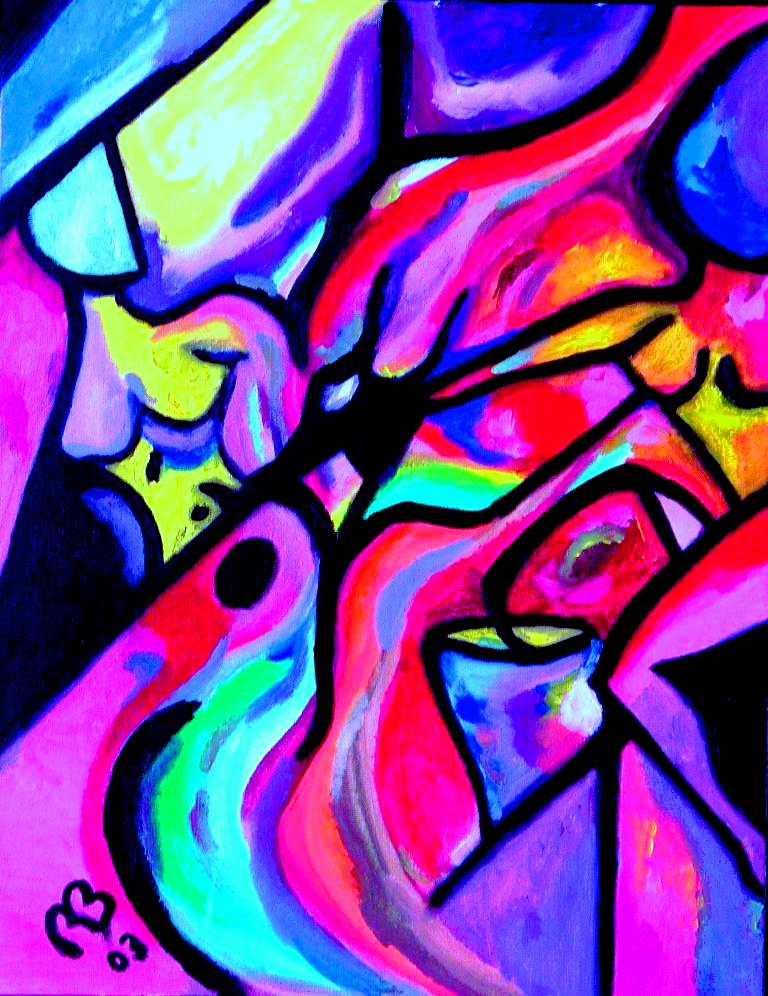
(Jazz in B Flat Minor, by FBC, image property of FBC, Omnia Caelum Studios Valencia. All Rights Reserved)
This one is really full of colours, almost an abstract but quite figurative indeed. So I decided it will make a good fine art print and it is available here at Fine Art America.
But there are many more works that may or may not make available as prints. Check them out here:
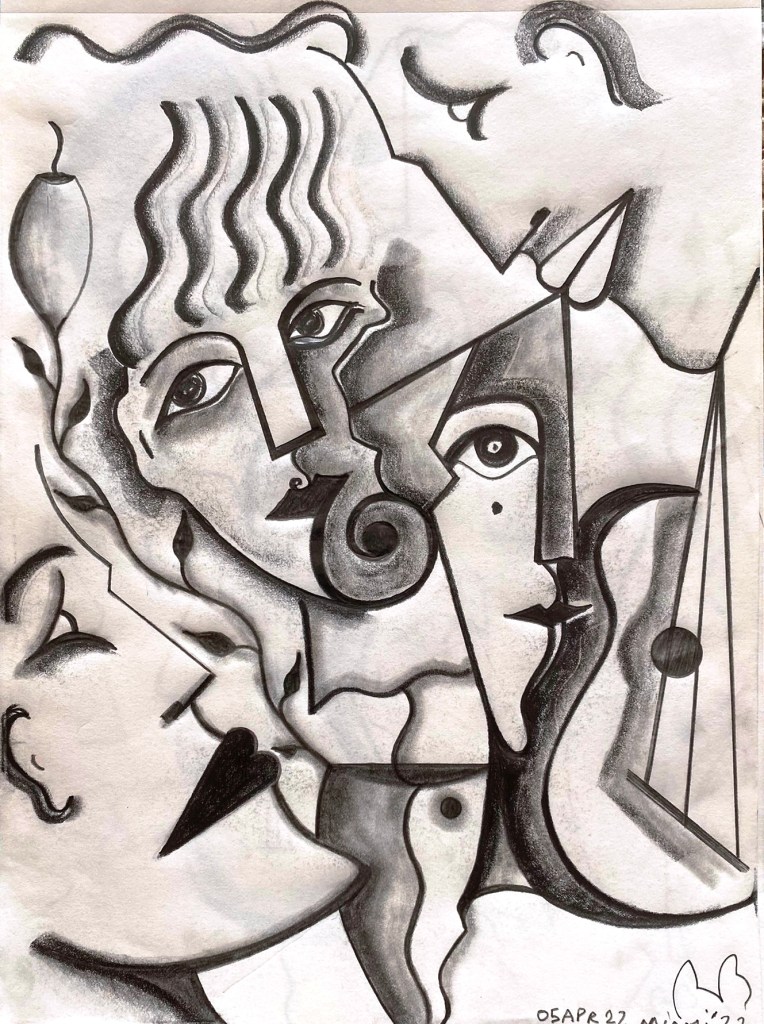
(JaZzArT drawing by Francisco Bravo Cabrera/property of FBC/Omnia Caelum Studios Valencia/All Rights Reserved)
I love to teach, (seen my video series on Art History? No? Follow the link, (there’s another one below), but there are some things that I just won’t teach to artists, or students, or art lovers, and that is how to draw. To learn to draw you have to take classes specifically geared at getting you acquainted with the different forms of graphite (pencils), charcoal, Conté Crayons, pastels etcetera etcetera. Then you learn to «see» and to «look» at your subject. Classes are good because they usually have models and I cannot do that from this blog…
But I will say that there are a few things that I can reach out and teach from this vantage point of mine, i.d. my blog, and that is I can try to guide you to think as an «artist» (whatever that is). First, there has to be an incredible urge to express, to reach out, to talk to someone out there, or to everyone. Musicians do that, and of course, their method (song, musical piece) is much more immediate, but we can do that with our art as well, now much easier thanks to the Internet.
Second, you have to know how to dominate and master your craft. That comes only with practice and time. And intimately tied to that is the development of talent. Talent is not something magical that is given to some and denied to others. Talent is a muscle that is developed through hard work. The more you draw the better you get, the more talented you get. Ever heard of «practise makes perfect»?
Don’t worry too much about creativity, imagination, originality or other such terms used by many to talk about art. Art does not depend upon creativity or on the artist’s imagination. And originality? What is that? Is there anything that has not been done before? Originality is not important. What is important is how you approach your subject matter and how you bring it to life on the canvas or the paper or with clay, bronze or even gold.
Art is created by the artist as a discipline, as a job well learned and well developed. It does not flow intuitively, like a child would do. And yes, intuitive art exists but it should exist solely as an experiment, or an exercise. But mainly as a way to get to a real work of art, which is something contrived and controlled, from beginning to end, by the will of the artist.
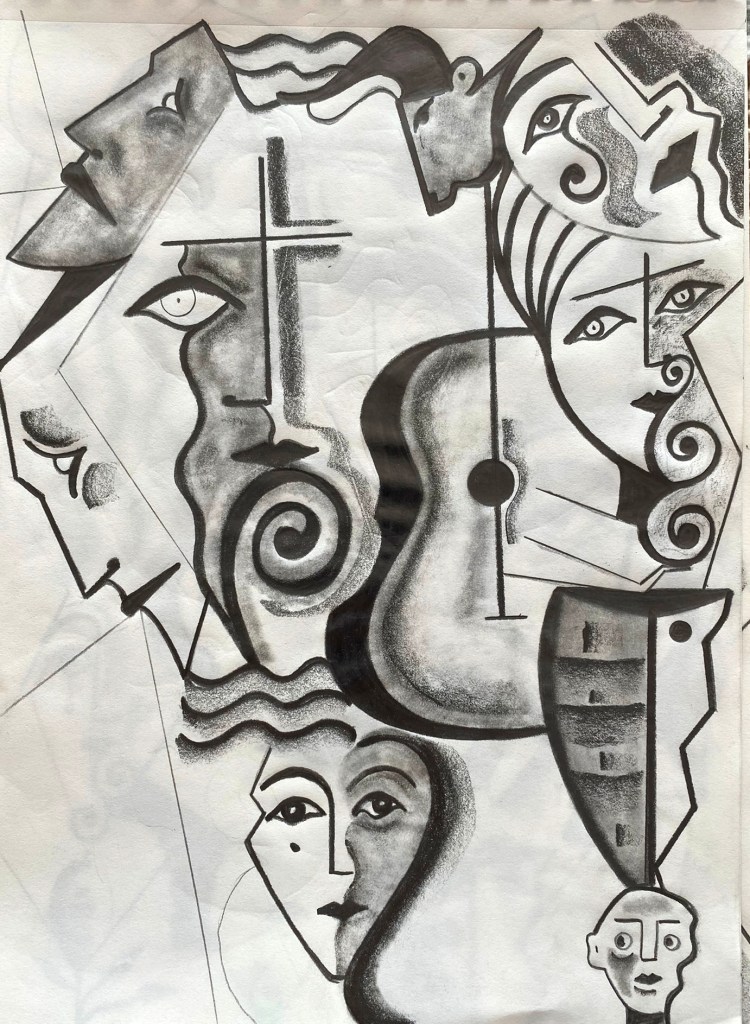
Here are some examples of some of the drawings I have been working on lately. Notice the line, and notice the development of the composition and how, after you know where your drawing is going, shadows are created, lines are reinforced or removed, altered, changed, in other words, turning the sketch into a finished work. And, of course, these are exercises, they are meant to be a finished work, but not something other than that, being a fully developed idea.
(Images property of FBC, Omnia Caelum Studios Valencia. All Rights Reserved)
I will leave behind one of the Art History videos that I have been doing and from that one you can find in my channel many more.