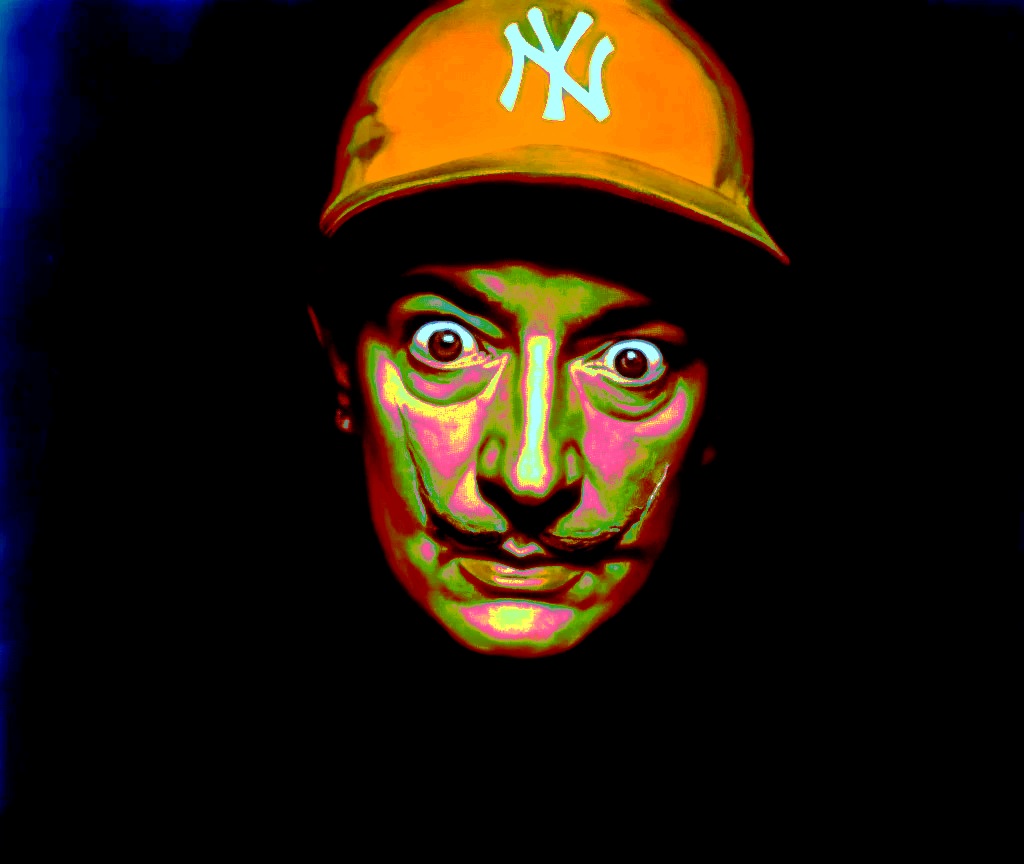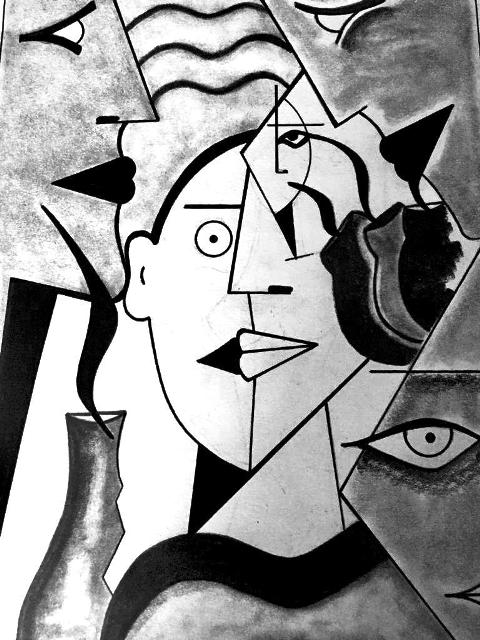
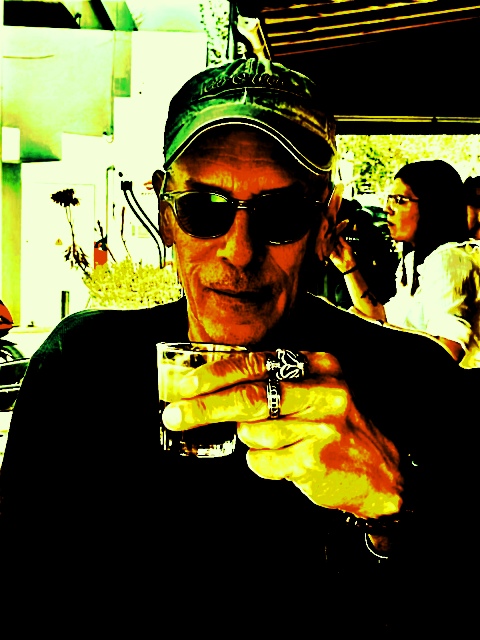
#poem, «One Day» (Francisco Bravo Cabrera)

(Francisco Bravo Cabrera/actor portrayal)

ONE DAY

One day I’ll when I am old and mad,
like a useless worn-out prostitute,
conversing with the cat…

Illuminated by a single ray of light,
as the afternoon recedes and fades,
I’m comfortable in my chair next to the window,
watching the world spinning away.

All things are complicated that once were simple…

I think I’ll take a walk down to the bar,
to grab a handful of potato crisps
and a glass of Irish “wine”.
I look around with wild intentions,
are those old friends,
or figments of my imagination?

But I must dance,
and dance I will,
though now alone,
my glass half filled,
the dance floor’s empty,
so are the eyes
of laughing ghosts whose envy
has kept them far from the sky.

The train has gone,
It’s steam still clinging to my skin,
I don’t travel anymore,
I just watch trains as a whim.

Sitting by my window,
I curiously take a peek
as the carnival is leaving
with its elephants and freaks.

My loved ones,
not so many,
hold a lantern in a storm,
afraid of me receding into madness all alone.
But like an old retired prostitute,
I wonder through the yard,
throwing corn flakes to the chickens
and reciting like a bard.

In truth I’m a survivor,
I’ve toasted every scar,
my tears are made of broken glass,
that broke through those nostalgic thoughts
I launched one day quite far.

The stormy seas can’t drown the music
that I played with my guitar,
so my bones will one day witness
the changing of the guard.

I’ve tasted bitter apples,
I’ve danced with girls sublime,
and a few quite ugly too
I’ve danced with over time.
But surprisingly enough,
I’ve lived to tell the tale,
of this old raging sycophant
that’s ordered one more ale.

One day I’ll be alone and old,
haunting these old hallways,
in a pose somehow unthinkable,
upside down like I’ve been always.

Francisco Bravo Cabrera – 8 SEP 2025, Izmir, Türkiye

«One Day» is another example of my «Jazz Poetry» from my upcoming book. The rhythm does not change, but the time does. Improvisation guides the strength of the story as it would a ghost who walks about just looking for a place to haunt…

CHEERS

#poem, «In Central Park»

(«Clouds Without Rain»/Francisco Bravo Cabrera/All Rights Reserved)

CENTRAL PARK

Who can change the course of history?
Who can stop the wheels of time?
Think you can?
Think they can?
Who is they?
And who are you to presume?

History is a mystery

Questions like these and many more,
bounce off the thin layer of surface water
that fills the depths of the reservoir in Central Park.
While it is quite necessary to investigate the lectionary,
Never should one doubt,
there are absolutes,
there are unchanging laws.

There‘s right and wrong,
there’s Ten Commandments,
miraculously carved in stone.
There’s the way of light and the way of darkness,
and you’re free to choose,
take your pick,
light or dark,
or take from both.

But human souls need human comforting,
We’ve all wandered far from home…

On a rotting bench, close to Central Park West,
sitting proper is Rosemary a retired secretary.
Her mind races from through to thought,
used to precision, speed and so forth.
But now quite old she’s not as bold and not as fast,
so when Augusts’ nights shine bright with Augusts’ lightning,
she still sits alone under the rain and
through her ears travels the rhythm and the cadence
of an old, old song, always the same.

I stood one clear January morning
near The Castle in Central Park,
and snow covered the ground,
I thought of summer
and not a question crossed my mind.

C.2021, Francisco Bravo Cabrera, 20 NOV 2021/30 AUG 2025, València, Spain/Izmir, Türkiye

#art, Are There Any Good Artists? (famous ones I mean)

(«Yankee Fan»/Francisco Bravo Cabrera/All Rights Reserved)

Many, either from within or without of the «art world», feel that there aren’t any good artists any more. That there are businessmen of art accumulating huge fortunes, but producing rubbish. And many of us feel that frustration with the art world right now. The high-profile names (Koons, Hirst, Emin, Kusama, etc.) are not even painters! They are mostly about spectacle, branding, and marketability. They thrive in the gallery–auction–collector ecosystem, which rewards shock, gimmicks, and recognisability far more than subtlety, craft, or genuine vision.

But that doesn’t mean that good painters don’t exist anymore. In fact, there are many remarkable contemporary painters working today — they just don’t always dominate headlines because they don’t fit the art-market circus model. Some examples:

  • Cecily Brown – British painter whose large, gestural works sit somewhere between abstraction and figuration, with real painterly energy.
  • Peter Doig – Scottish-born, Canadian-raised painter, creating atmospheric, dreamlike landscapes and figures.
  • Jenny Saville – Known for her monumental, raw depictions of the human body, technically virtuosic. (definitely one of my faves)…
  • Kerry James Marshall – American painter who explores Black identity and art history with both narrative depth and painterly brilliance.
  • Julie Mehretu – Abstract painter, blending cartography, architecture, and gestural abstraction in vast layered canvases.
  • Neo Rauch – German painter, mixing surrealism, socialist realism, and dream imagery in technically masterful ways.
  • Dana Schutz – Contemporary American painter, combining grotesque humor, bold color, and real painterly skill.

There’s also a huge wave of lesser-known artists working outside the mega-gallery scene — in local studios, regional galleries, or online — who are pursuing painting with as much rigor and creativity as any “old master.”

The tricky part is that the fame system in contemporary art doesn’t necessarily reflect talent. The business side rewards those who can generate headlines, big installations, or are able to move nuveau riche collectors who are trying to emulate the old rich but cannot have the paintings they already have, usually from the great masters, so they create new masters, (usually talent-less businss-savvy ones) and collect their art and pay exhorbitant prices for them. The «artists» think they are artists and they think they are collectors and it all works out because with a lot of money you can do many things. Meanwhile, many strong painters remain semi-underground or known mainly to curators and serious followers.

So yes — there are still excellent painters, even brilliant ones. But the system makes it seem as if all that’s left are marketers and showmen.

CHEERS

Quote of the day…

(Photo by and property of Francisco Bravo Cabrera/All Rights Reserved)

“The moon is one of the many mysteries I don’t think we’re ever meant to solve.” (Francisco Bravo Cabrera)

The photo captures the eclipse of the moon, a strange heavenly phenomenon totally unexplained…

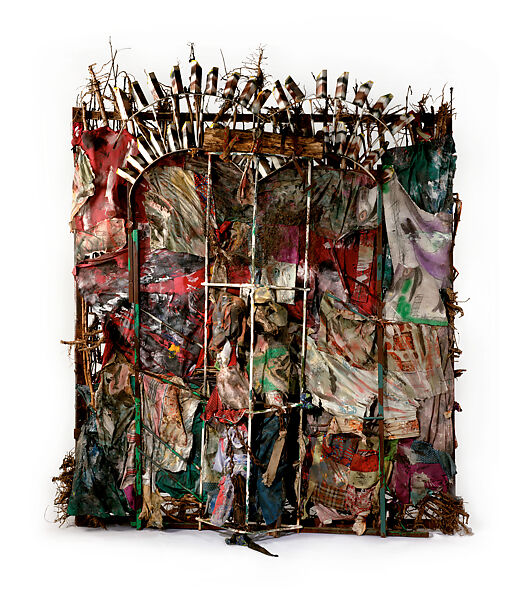
#art, Meet North American Artist Thornton Dial

(Image source: Souls Grown Deep Foundation)

Thornton Dial (1928–2016) was a «self-taught» artist, (well no one can teach themselves what they do not know, so he must have had some sources of learning to feed off from). This Black North American artist is today known for his powerful mixed-media assemblages with which he explored themes of race, history, social justice, and human struggle. Dial was born in rural Emelle, Alabama and grew up in the segregated South where he spent much of his life working in industrial and agricultural labor, particularly as a metalworker in a Pullman railcar plant.

Yet he began making art from an early age using discarded materials. This practice would prove central to his mature work. He made large-scale, densely layered sculptures and paintings that often incorporated found objects such as scrap metal, fabric, wire, and wood, transforming them into complex, emotionally charged compositions. The references for his work were mainly African American vernacular traditions, Southern storytelling, and abstract expressionism.

Of course he was ignored by the mainstream art world for much of his life, however, Dial gained recognition in the 1990s, thanks in part to the efforts of art historian William Arnett. Arnett helped bring Dial’s work—and that of other Black Southern artists—into major museums and galleries. Today, Dial is recognised as a major figure in contemporary North American art, and his work is held in the collections of institutions such as the Metropolitan Museum of Art, the Museum of Modern Art (MoMA), and the Smithsonian American Art Museum.

Thornton Dial’s art is widely regarded for its visual power but it is also important because of its deep moral and historical value which offers a clear and proper commentary on the Black experience in North America.

Here are some examples of his work…

(«The Art of Alabama»/2004/Image source: Souls Grown Deep Foundation)
(«History Refused to Die»/2004/Image source: The Metropolitan Museum of Art)
(«Out of the Darkness The Lord Gave Us Light»/2003/Image source: Souls Grown Deep Foundation)

CHEERS

#opinion, Dear Diary, Page 194 – Querido diario, P.# 194

(Image photo by and property of Francisco Bravo Cabrera/All Rights Reserved)

I have been wondering about The Mandela Effect, and my research confirms that it is a very real psychological phenomenon, but probably not real in the sense of being proof of alternate universes.

The term was coined by Fiona Broome after she discovered that many people (herself included) remembered Nelson Mandela dying in prison in the 1980s, even though he actually passed away in 2013. Since then, people have found countless examples of false collective memories like:

• The Monopoly Man – Does he have a monocle?

• “Febreze”- Is it spelled with one “e” in the middle, or two?

• Is it “Luke, I am your father”?

* Does the Fruit of the Loom logo actually have a cornucopia?

(What do you remember?

+++

Psychologists (good grief experts!) say it is because memory is reconstructive, and that every time we recall something, we “rebuild” it. And often we do it based upon influences, associations, expectations, or cultural reinforcement. «Experts» conclude that if a false version…of something like the death of Nelson Mandela…spreads widely enough, it can feel real to a group of people.

They (good grief experts!) have already a set of replies that will logically take the magic and the illusion from all of us. They say it is confabulation, in other words, the brain is filling in the gaps of memory. They also tell us that the brain remembers what fits rather than the exact details. Finally they say that we remember what others say they remember therefore strengthening the «false memory.»

In other words, to experts we are too stupid to remember what we say we are remembering and we forget what really happened. Does that make sense? No! Of course, experts, as usual, are making up bullshit as they go and always trying to tell us that we are just imagining things. Especially things like Bigfoot, aliens, the Mandela Effect and the Multiverse hypothesis.

But the Mandela Effect can be our most important and real indication of the fact that the universe is not limited to us and that there are many universes and timelines out there. The Mandela effect, in effect, is time itself slipping in and out of parallel universes across the multiverse. I just do not understand why «experts» always contradict a good story!

CHEERS

What do you think?


#opinion, Dear Diary, Page 194 – Querido diario, P.# 194

(Image photo by and property of Francisco Bravo Cabrera/All Rights Reserved)

I have been wondering about The Mandela Effect, and my research confirms that it is a very real psychological phenomenon, but probably not real in the sense of being proof of alternate universes.

The term was coined by Fiona Broome after she discovered that many people (herself included) remembered Nelson Mandela dying in prison in the 1980s, even though he actually passed away in 2013. Since then, people have found countless examples of false collective memories like:

• The Monopoly Man – Does he have a monocle?

• “Febreze”- Is it spelled with one “e” in the middle, or two?

• Is it “Luke, I am your father”?

* Does the Fruit of the Loom logo actually have a cornucopia?

(What do you remember?

+++

Psychologists (good grief experts!) say it is because memory is reconstructive, and that every time we recall something, we “rebuild” it. And often we do it based upon influences, associations, expectations, or cultural reinforcement. «Experts» conclude that if a false version…of something like the death of Nelson Mandela…spreads widely enough, it can feel real to a group of people.

They (good grief experts!) have already a set of replies that will logically take the magic and the illusion from all of us. They say it is confabulation, in other words, the brain is filling in the gaps of memory. They also tell us that the brain remembers what fits rather than the exact details. Finally they say that we remember what others say they remember therefore strengthening the «false memory.»

In other words, to experts we are too stupid to remember what we say we are remembering and we forget what really happened. Does that make sense? No! Of course, experts, as usual, are making up bullshit as they go and always trying to tell us that we are just imagining things. Especially things like Bigfoot, aliens, the Mandela Effect and the Multiverse hypothesis.

But the Mandela Effect can be our most important and real indication of the fact that the universe is not limited to us and that there are many universes and timelines out there. The Mandela effect, in effect, is time itself slipping in and out of parallel universes across the multiverse. I just do not understand why «experts» always contradict a good story!

CHEERS

What do you think?


#poem, «I Live Alone Without A Master»

(«JaZzArT» by Francisco Bravo Cabrera/All Rights Reserved)

I LIVE ALONE WITHOUT A MASTER

Watching,
waiting…
To the 90th minute,
zero – zero,
no goals,
bad luck wearing number 10,
tried again and again
but nothing…

A thought of you,
the one who fills my dreams,
especially when I’m with another,
so that when I’m with you
I dream of all those others…

A house is just a labyrinth
constructed caresses and decorated with kisses,
not for me, I’m a cat that loves the rooftops
the city’s home and I live alone,
without a master.

And come the weekend:
bars and clubs filled with gals and fellows
that look like they belong in a wax museum.
Intoxicated by the kisses that I get
from those who share with me
their precious souls filled with bitterness,
I offer one a gladiolus
for solace.
Another I offer a yellow rose,
and urge her to grab it by the thorns,
so that her fingers bleed,
I need fresh blood to penetrate this suburban purgatory
where I’ve made a place for weekends.
It’s a dungeon, but who wants to roam free
when one could be wrapped in these chains of misery…

But come Monday,
we again begin the story
of the daily litany,
the cold war over coffee,
the insipid fall from grace,
forty eight hours of heaven,
and now a phone,
a desk,
this place
where fluorescence tortures my retina,
and blue ink drains my brain.

And when I’m with another I think of you,
and when I’m with you,
with all the others…

C.2025, Francisco Bravo Cabrera – 06 SEP 2025 – Izmir, Türkiye