Welcome back to our series on art history. We continue with some painters of the Spanish Renaissance. And we hope that this will provoke you to seek more, research more and investigate. Art history is very important to both artists, who need to know it and know it well, and to art collectors or lovers of art who will appreciate the art they love so much more. We would like to feature the Renaissance art of other European countries, if there are many likes to videos like this one. So if you promise to give us a like, we promise to continue with the series. Stay in touch.
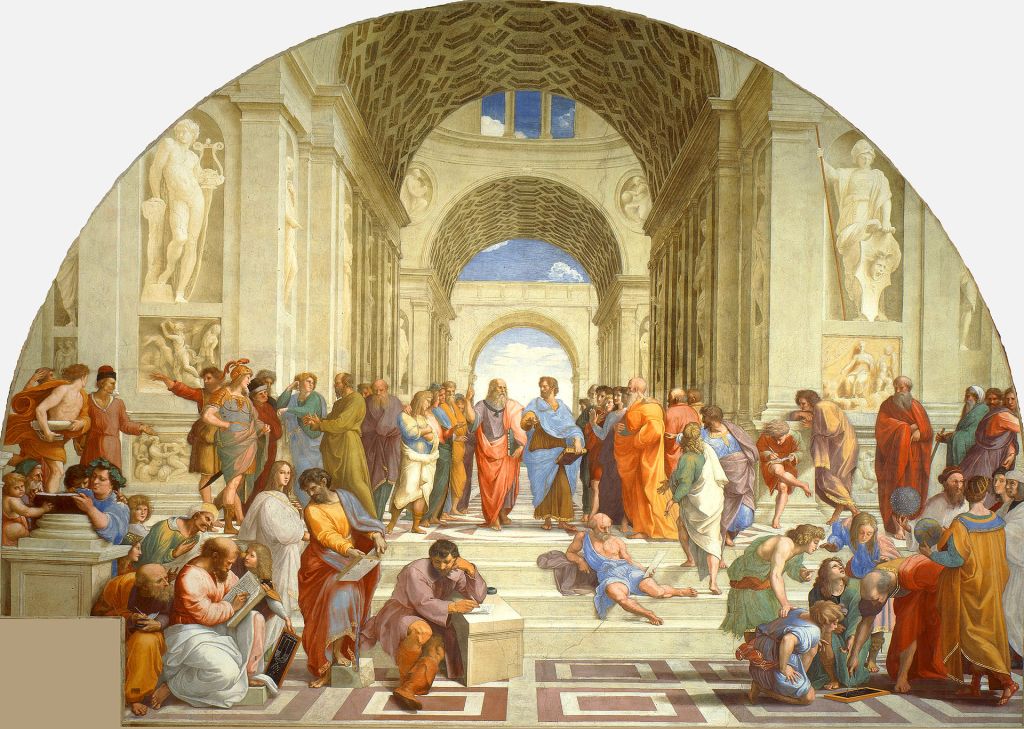
From the QUATTROCENTO we now enter the CINQUECENTO, or the High Renaissance. Now, remember that we are concentrating totally in Italy. There were other things going on in Europe which we will look at shortly.
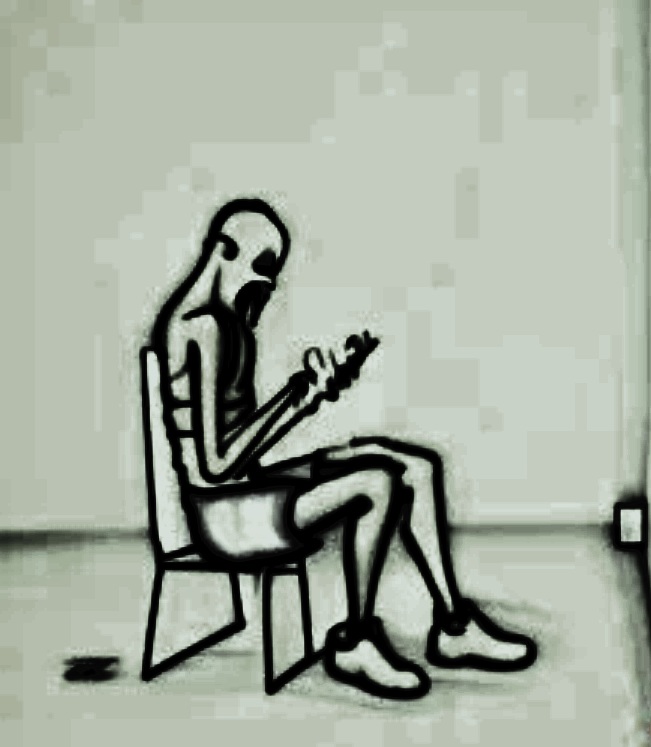
(«El tonto y el móvil»/Francisco Bravo Cabrera/Derechos Reservados/All Rights Reserved)
Querido diario, tu sabes que nunca he sido de pasarme horas en el gimnasio, pero si de pasarme horas practicando Yoga, Tai-Chi, Kempo Karate, Ballet Clásico y Danza Jazz Moderna. Tambien haciendo senderismo y alpinismo, pero… Resulta que un vecino/colega ha abierto un gimnasio muy cerca de casa y me ha dado de alta gratis y bueno, fui… ¡Madre mía! Habían maquinas de todo tipo y en cada una un tío, o una tía, sentados metiendo dedo en el móvil. Pensé, ¿No hacen ejercicio? Pero, ¿Qué coño hacen aquí esta gente? Y todos los días me encuentro con lo mismo, supuestos miembros del gimnasio que vienen a leer sus correos, chatear, buscar ligue online, o simplemente a comer mierda con el móvil en vez de hacer los putos ejercicios y marcharse a casa… No entiendo esto, la verdad que no lo entiendo. Le sugerí a mi colega que no permitiera teléfonos móviles en el gimnasio pero me dijo que eso significaría la perdida de los borregos, digo, la clientela… 🙄
+++
Dear diary, you know I have never been one to spend hours at the gym (to me it is the James as we are still not well acquainted). But that I do spend hours practicing Kempo Karate, Tai-Chi, Yoga, hiking, dancingand doing other types of calisthenics. But a colleague opened a gym and gave me free admission and I went. Good grief! There were all sorts of phenomenal machines and on every one of them a bloke or a bird was sitting fiddling round with their mobile phones!Oy! You come here to work-out or to chat, email or look for a date online? I really felt like saying this, but, you know me, dear diary, I am not an aggressive sort that likes to confront others or antagonise them.But this is really absurd, I truly do not understand it, at all. So I mentioned to my colleague that he should prohibitmobile phones in the gym and he replied, looking at me as if I was from Mars and said that would ruin his business! The sheep have to have a place to sit and wonder, at the black screen of a mobile phone…
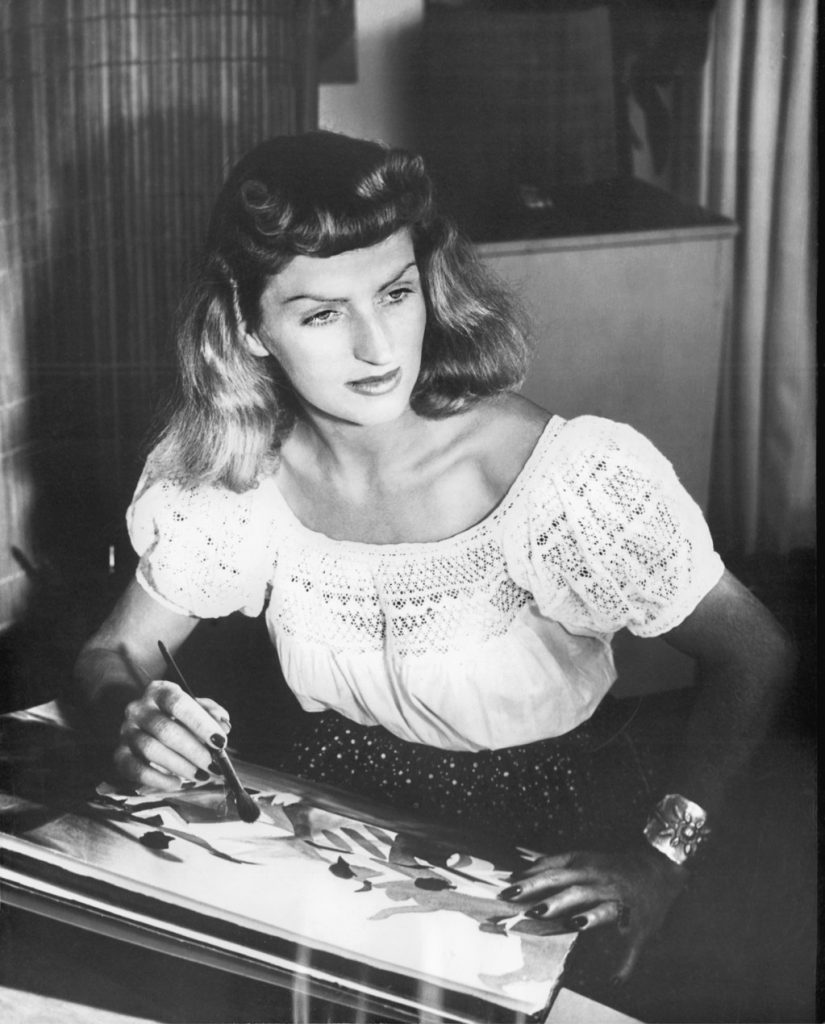
(Photo by unknown photographer taken from Diseñadoras gráficas)
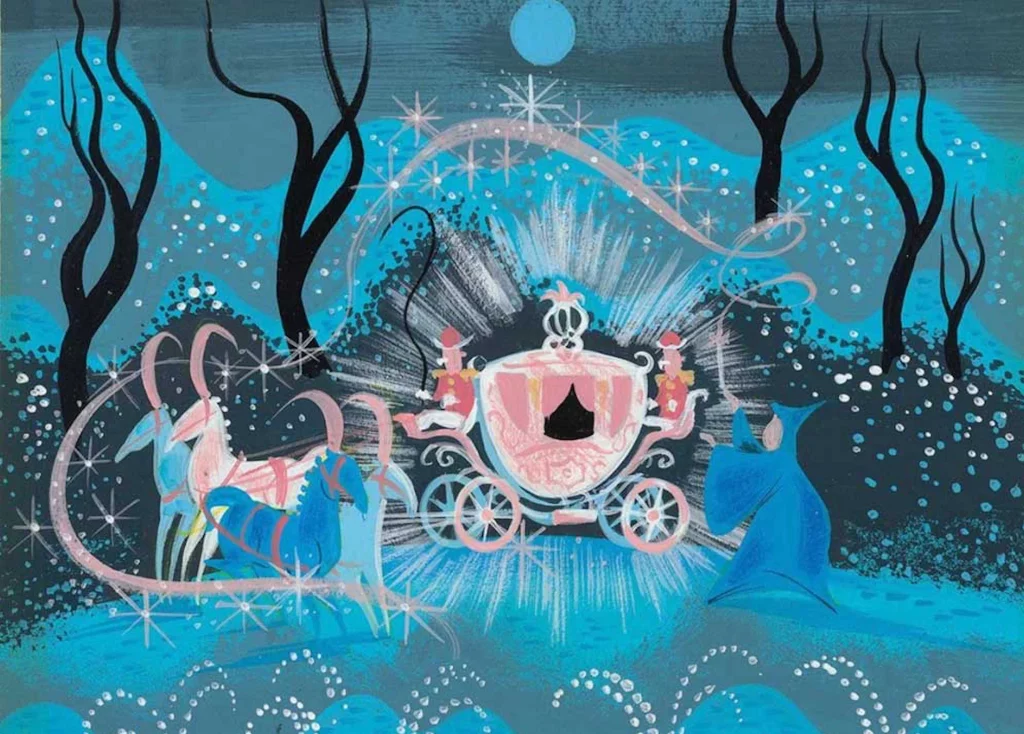
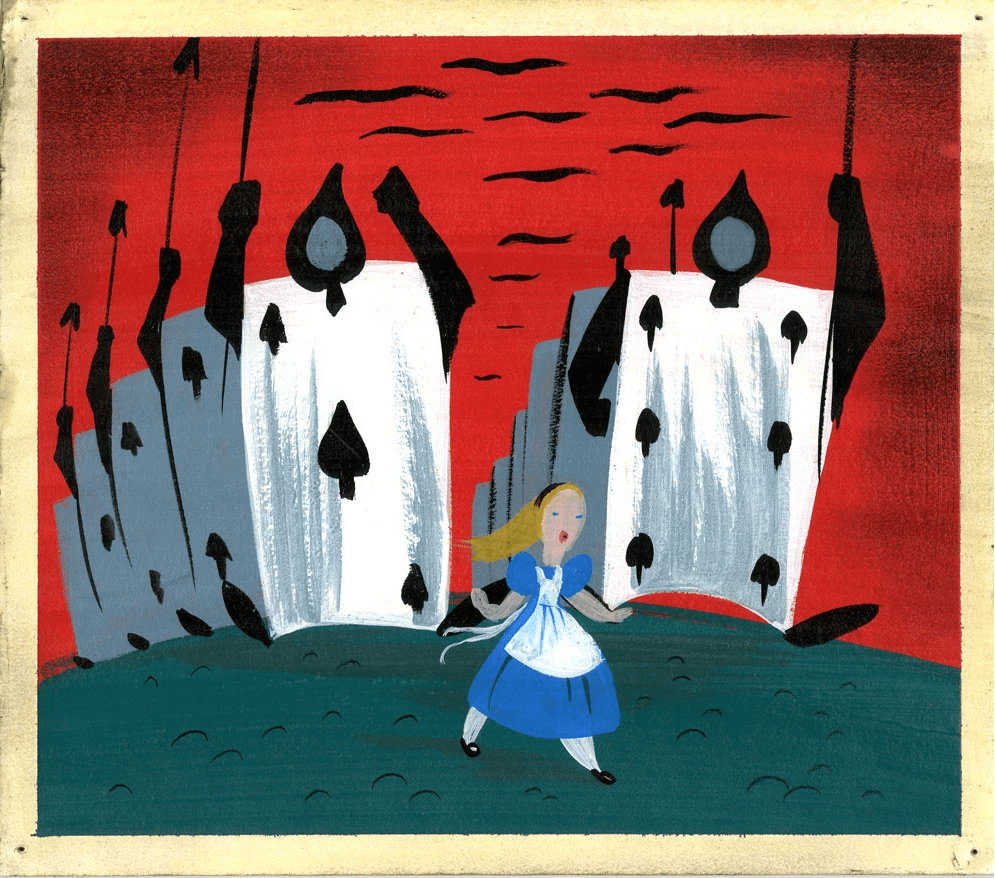
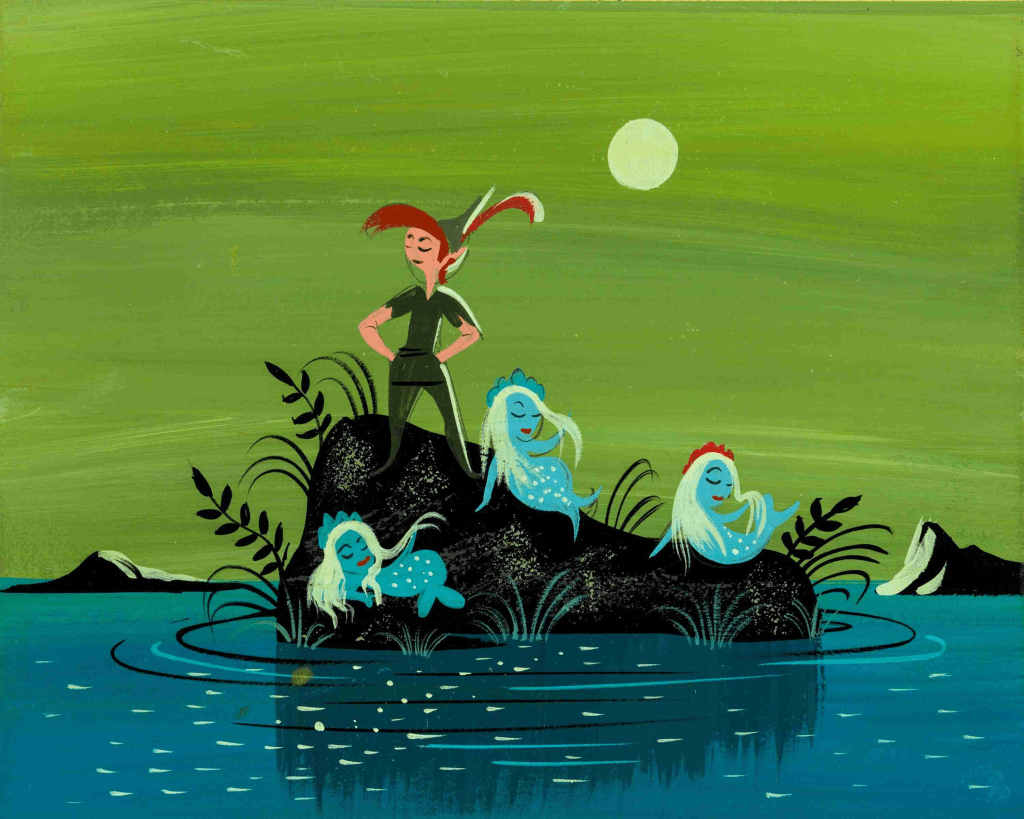
This is another one that they never told me about, although her work probably has been seen by so many without ever knowing who she was. Mary Blair, (1911-1978), North American artist and graphic designer, was born in Oklahoma. Blair produced the drawings and the concept art for the Walt Disney Company for such movies as Alice in Wonderland, Peter Pan, Song of the South, and Cinderella. She also designed some of the characters for the Disney theme parks such as for It’s a Small World, the fiesta scene in Epcot’s The River of Time and the large mosaic inside the Disney Contemporary Resort. During the 1950’s she illustrated several children’s books that are still being edited today like I Can Fly by Ruth Krauss. In 1991 Mary Blair was awarded the honour of being inducted into the Disney Legends Group.
Mary was well educated in the fine arts. After graduating from San Jose State University (1931) she won a scholarship to the Chouinard Art Institute in Los Angeles (1931-1933). Her professors were such artists as: Pruett Carter, Morgan Russell and Lawrence Murphy. She graduated from Chouinard in 1933. Her husband, Lee Everett Blair (1911-1993), was also an artist, as well as her brother-in-law Preston Blair (1908–1995). Both Mary and her husband were members of the California School of Watercolor (sic). There they were well known for being imaginative colourists and designers.
Her first job in animation was for Metro-Goldwyn-Meyer. She joined Walt Disney Animation Studio in 1940.
Mary Blair died of a cerebral haemorrhage in 1978, possibly due to alcoholism.
If you are an artist, art student, or interested in the fine arts, I would strongly urge you to follow up and read more on Mary Blair and on anything related to art. As I always say, «Art is the search». So keep on searching folks, it is the only way to find.
Here are some samples of her work I hope you like:
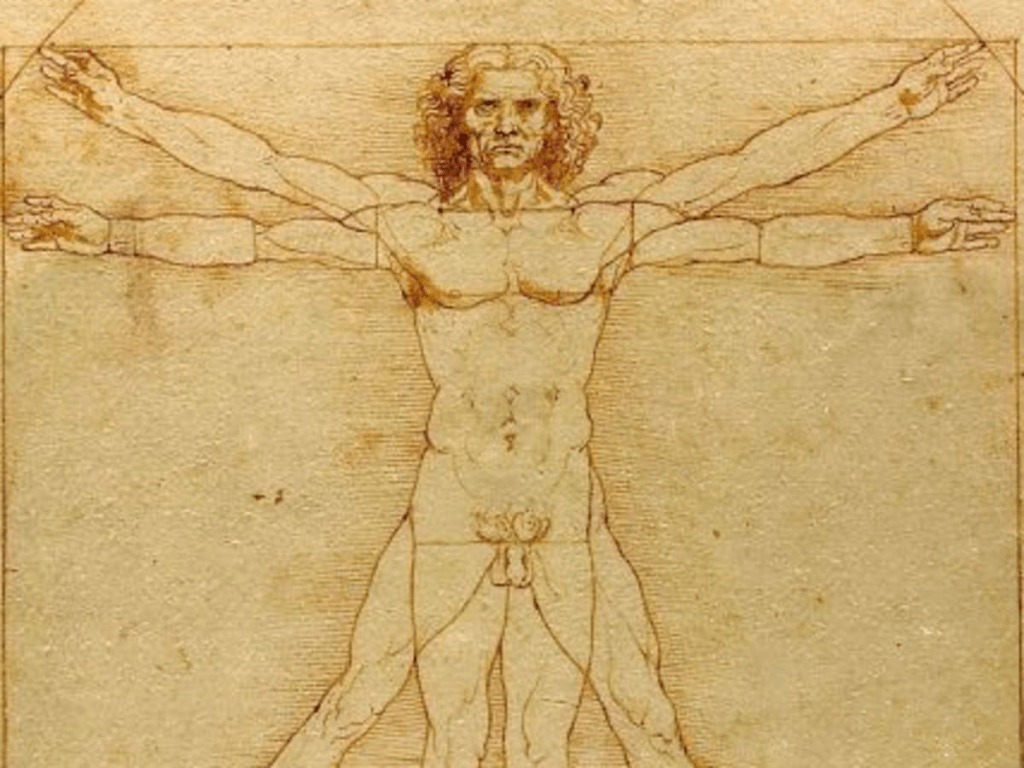
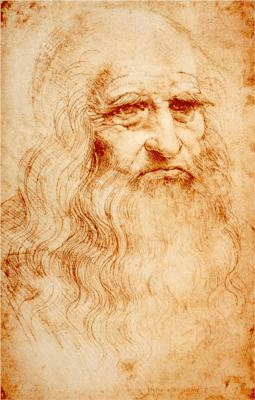
The great Renaissance man? The genius? The artist, inventor, poet, researcher? Or the lazy rich boy who coasted through the years, living in comfort with servants and being trained by some of the masters of the time?
I think the latter description suits him better…
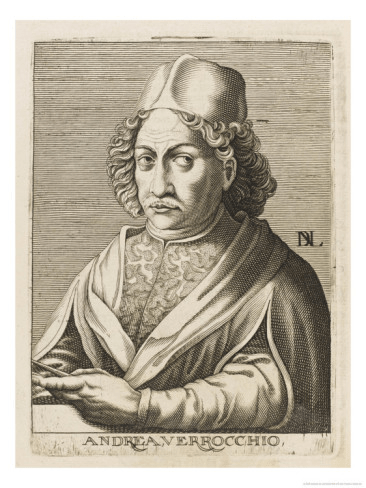
First I must say that I do think he was a great illustrator and painter. No doubt. But I also must ask myself, how many other young students of art also painted as good…or better…than the famous Tuscan? If other young lads would have had the same opportunity to train with the great Master Andrea del Verrocchio, like Leonardo had, thanks to his rich father, I am sure they too would have created incredible works of art.
(Andrea Verrocchio)
Leonardo da Vinci hardly ever finished what he started. When he found the going rough, he abandoned the project. The famous fresco «The Last Supper», which he painted on the wall of the refractory of Santa Maria delle Grazie, the church and convent of the Dominican Order in Milan, has had to be restored many times because it was painted using tempera and now little of the original remains. What kind of artist…with the experience of Leonardo…would be so careless?
Leonardo left many paintings unfinished, not only the «Monna Lisa» (which I will return to promptly), but «The Virgin and Child with St. Anne», «Saint Jerome in the Wilderness», «The Adoration of the Magi» as well as many other projects. All of his inventions were left unfinished and none of them would have worked had they ever been built, which they were not. Actually Duke Ludovico Sforza only engaged Leonardo to make entertaining objects, and such that could be used for decoration. The equestrian statute he commissioned from him was never even started, it remained as a sketch.
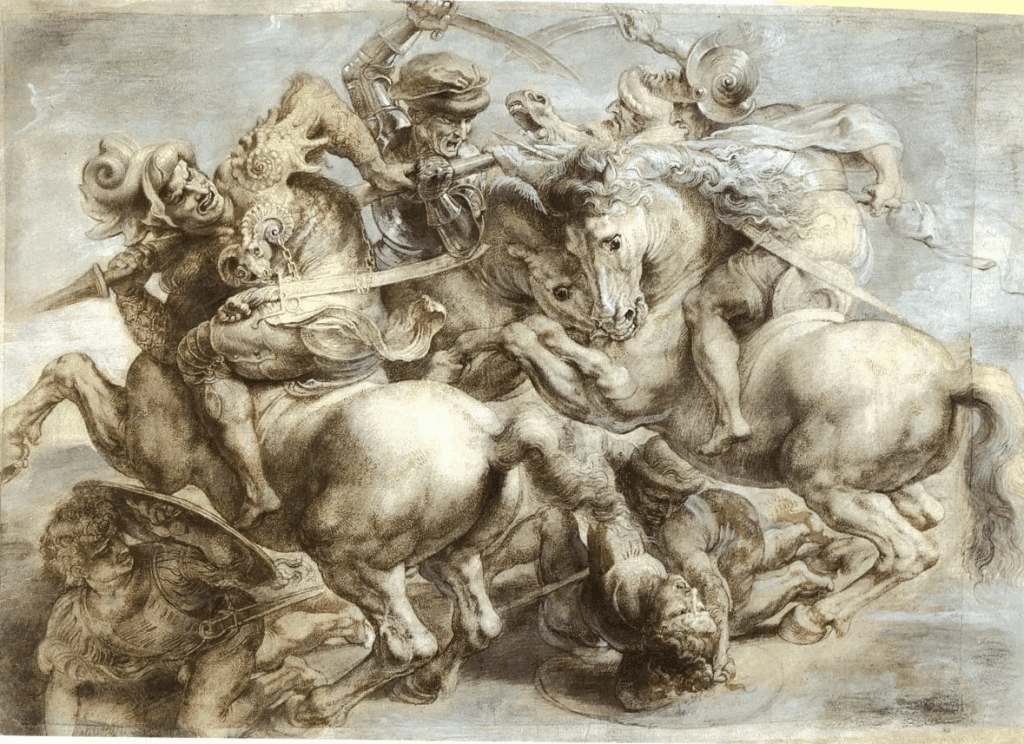
One of his greatest failures was the fresco of The Battle of Anghiari (1505) which he was commissioned to paint on the walls of the Palazzo Vecchio in Florence ,and which he never painted. Leonardo, (the great innovator?), tried to paint with oil but placed a much too thick undercoat with wax and when he applied the colours they began to drip and he gave up and abandoned the project.
(Peter Paul Rubens’s (1603) The Battle of Anghiari)
So, in conclusion…and in my opinion…Leonardo da Vinci was no greater…and much lesser…than his contemporaries, great artists, who truly worked hard, like: Michelangelo, Raphael, Sandro Botticelli, Pietro Perugino, Donatelo, and the master of masters, Filippo Brunelleschi, the architect/engineer/artist that truly kicked off the Renaissance in Italy.
Reference Monna Lisa…
I look at it as a little painting of not much importance to me. I looked at it (when I visited Le Louvre) for less than a second and the painting did not really catch my eye. It is small, 77 x 53 centimetres and not very interesting. I would say it is a second rate portrait. Well, then why is it so famous? Because it was stolen and remained missing for two years and during that time it received a lot of press, making the painting famous…
(Monna Lisa, 1503-1519)
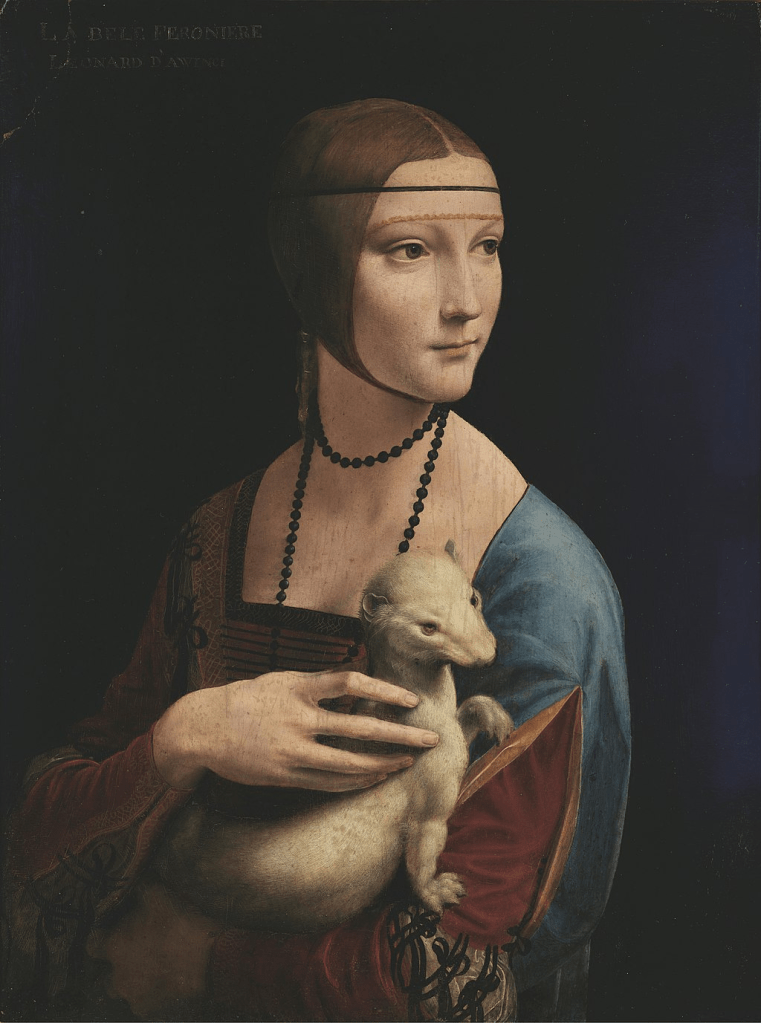
Can anyone really say that this painting, Monna Lisa, is better than this one:
(La dama del armiño, 1489-1491)
Now it is your turn to tell me what you think.
(2021)
And I do think he was a great artist, a great illustrator but he did not really pay too much attention to his craft and gave up too quickly when things went wrong…
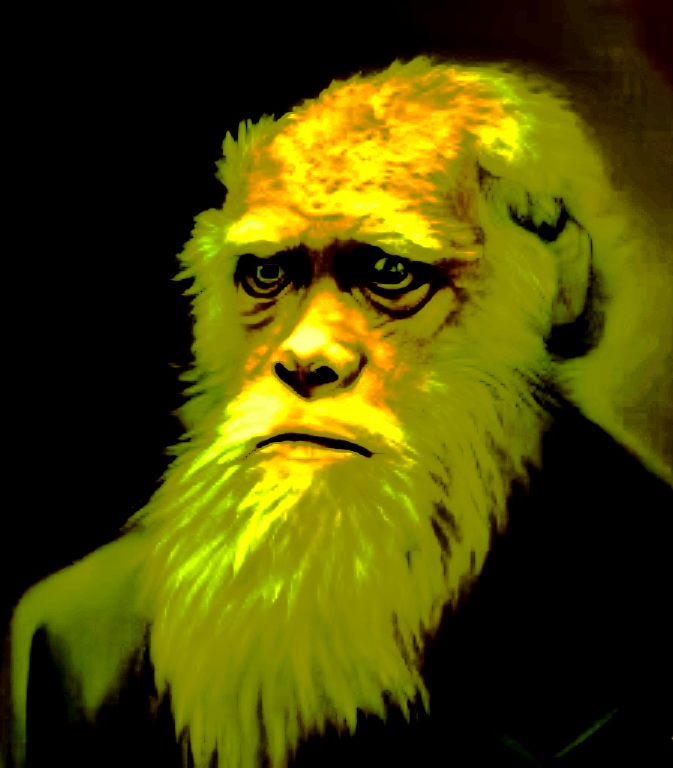
(«Darwin-Mono-Evolucionando»/Francisco Bravo Cabrera/All Rights Reserved/Derechos Reservados)
People like to use words that they think have special meanings and that clarify their arguments, but in effect they are simply mis-employing terms. One is «evolution.» According to the muckety mucks, namely one Charles Darwin and his parishioners, man evolved from a monkey that decided one day that he would walk on two legs, stop eating bananas and instead of living in the trees, moved to suburbia. Well, mister brilliant scientist, you missed the boat because monkeys (like most animals on Earth) are much more adapted to life on this planet than we (Homo Sapiens) are. For one, they do not need governments, they do not pay taxes, they do not suffer from sunburn and they do not have spinal maladies like a lot of us men and women of the world. So if we take your theory with a grain of salt, we can logically deduce that we we are the de-evolution of a monkey. Imagine that!
And what about art you are asking? I will tell you. Art has never evolved. Art, since the first rupestrian paintings in the caves to Egyptian, Roman, Byzantine, Arabic, Indian, Chinese, Japanese, Aztec, Maya, Navajo, has existed completely and fully. It has not grown flippers, lost legs or gained wings. The idea of art evolving is ridiculous at best and at worst a lie perpetrated by those who would like to control art history. Ancient art, Renaissance art, and the art of every epoch throughout history has changed, as it should. Developing new styles, new techniques, new paints, new brushes, new canvases etc, does not mean evolution. Each period in art history has its art and it is still as valid today as it was when mande and if you don’t believe it go to an auction at Sotheby’s or Christie’s and see what people are paying for such masterpieces.
Here I leave you with a short video of art that is as precious (and as complete) today as it was the day it was done. No evolution required. The painter, the artist, or the sculptor needs to grow with the times, capture the spirit of his time and work with it. That is how art develops.
(Art Digital by Francisco Bravo Cabrera/All Rights Reserved)
Why do I say that? I mean, why do I say that art is the search. The search for what? And ultimately, what is art? If you study art history you discover that centuries ago it was quite easy to define what art was. As a matter of fact, many of the famous Renaissance artists that we think of as the Masters these days did not even call themselves artists. They considered themselves as artisans. It wasn’t until artists started choosing and deciding what they were going to paint or sculpt that the idea, the concept of being an artist was developed. Before that, artists like Michelangelo and Bernini did not choose what they were going to paint, it was commissioned to the. They painted what the Church or what a rich noble wanted, or what the King or Queen desired.
So, when artists were free to choose their subject matter, art evolved rather quickly and that is when art became the search. As an artist you must possess certain qualities, and these are: Education, Preparation, skill, insight and good taste. Without any one of these you may not succeed as an artist. (Unless you get yourself someone with lots and lots of money to sponsor you, promote your work and place you at the pinnacle of the art world. It is being done with many no-talent artists doing no good art).
In any event, that is why I say that art is the search. In the search you filter out the mundane, the ordinary, the uglier aspects of life and you keep that which can transmit a message, enhance someone’s life and enrich your own creative spirit. As an artist you must have the spirit of the times, live in the moment and search through history to conclude with a work that reflects the times and speaks to the future.



 JaZzArt en València