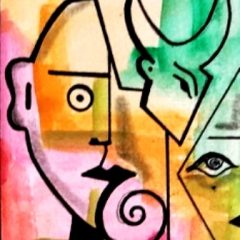
(«The Shadow of an Expression»/Surreal-Expressionism by Francisco Bravo Cabrera/All Rights Reserved)
YOUR SHADOW
Stay strong always, brave, daring. Who shall you fear? March on even when weary life will give you no reprieve, you must defy her with every turn…
Your shadow is not your rival, it is your guide… Your steps will pave the road, and though it may be twisted, with each stride you find it straight.
See the road through gentle eyes. Your shadow never leaves you; watch closely as it smiles, and with a wink it beckons you toward the tavern where you’ll find good wine, potato omelette, pork sausage, Iberian ham, blood sausage, it’s a true delight.
Your shadow never betrays you, listen to its counsel for it knows more than what was drummed into you by the donkeys of the academy, in their foul chambers where indecency gleams.
They may use you like a rag, but your shadow, foolish human, cannot be deceived, not for one moment.
Francisco Bravo Cabrera / August 12/22, 2025 / Izmir, Türkiye
(Bodo Vespaciano/Not the real Bodo, actor portrayal/All Rights Reserved)
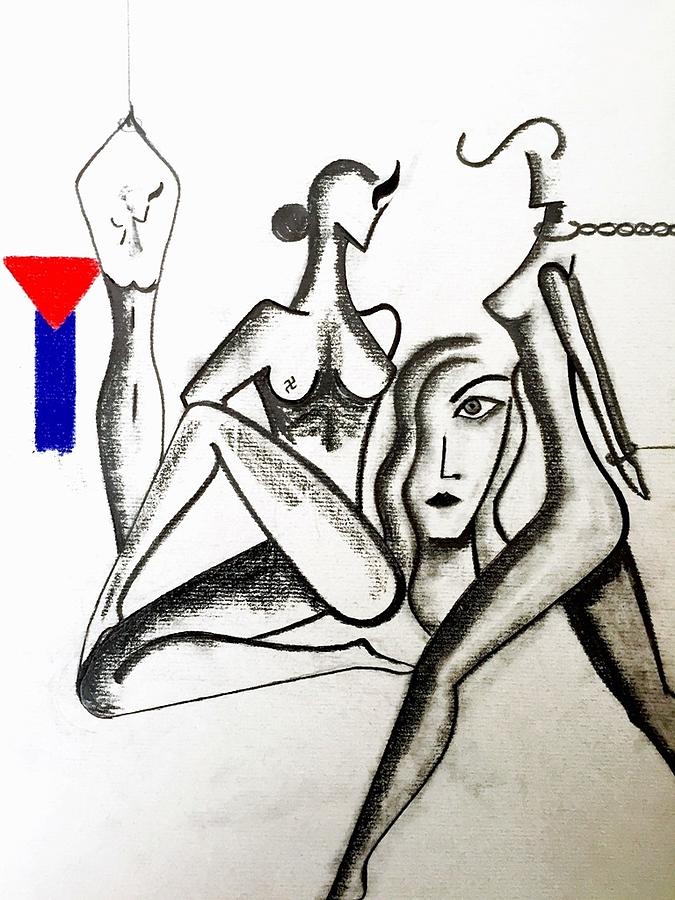
Canción Cuba (A series of drawings by Francisco Bravo Cabrera also known as Bodo Vespaciano from the Omnia Caelum Studios Miami days 2003-2018)
These three drawings represent much of what I learned while living in Miami among Cuban exiles. The original migration of Cubans to Miami began in 1960 and ended in 1962 when the October Crisis (Missile Crisis) ended relationship between Cuba and the United States. During those two years thousands of Cubans were invited to come to the US, (in a legal and orderly manner and via commercial flights by Pan-Am and Cubana de Aviación), and given refugee status as they were fleeing a communist dictatorship that had taken over the government of their country. The Cuban community (the historic exile community) settled mostly in Miami, Florida and in the New Jersey cities of West New York, Hoboken and Union City.
The series, done in my unique surreal-expressionist “JaZzArT” style, attempts to portray the beauty and the grace once found in Cuba which ended after the takeover by the communists. I have attempted to recreate that same beauty and grace and represented it with female figures, but in chains, like everyone else when living under a dictatorship. The communists, under dictator Fidel Castro altered the rhythm of life in Cuba, subdued the will of the people, took away their liberty, and replaced freedom with utter and complete destruction.
Although the people were made vassals of Fidel Castro and his communist regime, in my rendition and analogy they were resilient enough to seek the wisdom (represented by the owl) to emigrate and seek growth in a neighbouring land. They came to the US, not as economical immigrants but as seekers of freedom and individualism, to a land where these institutions were cherished, protected and guaranteed for all. I hope that the US never loses them.
(All Rights Reserved)(All Rights Reserved)(All Rights Reserved)
(Original drawings by Francisco Bravo Cabrera, a.k.a. Bodo Vespaciano/All Rights Reserved)
(We kindly ask you to please like, comment, share and subscribe as this helps our channel)
Canción Cuba (Una serie de dibujos de Francisco Bravo Cabrera, también conocido como Bodo Vespaciano, de los días de Omnia Caelum Studios Miami, 2003-2018)
Estos tres dibujos representan gran parte de lo que aprendí mientras viví en Miami entre exiliados cubanos. La migración original de cubanos a Miami comenzó en 1960 y terminó en 1962, cuando la Crisis de Octubre (Crisis de los Misiles) puso fin a la relación entre Cuba y Estados Unidos. Durante esos dos años, miles de cubanos fueron invitados a venir a los EEUU, (de manera legal y ordenada y a través de vuelos comerciales de Pan-Am y Cubana de Aviación), y se les otorgó estatus de refugiados pues escapaban de una dictadura comunista que había tomado el control del gobierno de su país. La comunidad cubana (la comunidad de exiliados históricos) se asentó principalmente en Miami, Florida, y en las ciudades de Nueva Jersey de West New York, Hoboken y Union City.
La serie, realizada en mi estilo único, el «surreal-expresionismo – JaZzArT”, intenta retratar la belleza y la gracia que existió en Cuba antes de la revolución, y que se perdió una vez que la misma se tornó Marxista-Leninista. He intentado recrear esa misma belleza y gracia y la he representado con figuras femeninas, pero encadenadas, como todos los demás que tienen que vivir bajo una dictadura. Los comunistas, bajo el dictador Fidel Castro, alteraron el ritmo de vida en Cuba, sometieron la voluntad del pueblo, quitaron su libertad y la reemplazaron con la destrucción típica de los regímenes comunistas.
Aunque el pueblo fue avasallado por Fidel Castro y su régimen comunista, en mi interpretación y analogía, no todos se dejaron inculcar ese virus tan mortífero y esos supieron buscar sabiduría y un futuro en libertad. Emigraron en busca a una tierra vecina, EEUU. Y llegaron, no como inmigrantes económicos, sino como buscadores de libertad e individualismo y aportaron mucho a esa tierra donde esas instituciones son valoradas, protegidas y garantizadas para todos. Espero que los EE. UU. nunca las pierda.
CHEERS – GRACIAS
(We kindly ask that you please like, comment, share and subscribe to our channel)
(«Ghostly Faces on the Wall»/Francisco Bravo Cabrera/All Rights Reserved)
“Changing of the Guard” (An Euro-Ku)
These city streets recall my passing and remember my footsteps, on each corner and pass from mouth to mouth stories I had quite forgotten, while faces in the winds blur like smoke, but the echoes of their voices always linger.
I pass greeting the shadows of old promises, my hands reaching for what I had lost, like a crown of fleeting triumphs that precariously balanced on my head.
Moonlight permeates the darkened wall, and the changing of the guard, unseen by only me, leaves behind only the pulse of time.
C.2025 – Francisco Bravo Cabrera – 21 AUG 2025 – Izmir, Türkiye
NOTA BENE
An Euro-Ku is my invention from 2022. As I admire the original Japanese poetry form, I wanted to write in the style. However, being a Westerner and not having the benefit of the Japanese culture, language or history, I felt I could not honour the original Haiku. So I thought it would be beneficial to create a similar form but suited to the European mentality, history and culture. The Euro-Ku still maintains the three stanzas or verses, however, since it is written in English, (or any other European language), it made no sense to stick to the strict syllabic count, which works for Japanese but not for any other language. So there are no syllabic counts or restrictions in the Euro-Ku. Another rule, if I may, is that the verses must flow easily and logically into each other completing the thought and the story. No verse should just flow into outer space. And finally the Euro-Ku must be accompanied by an original, inedited illustration made by the author specifically for the poem.
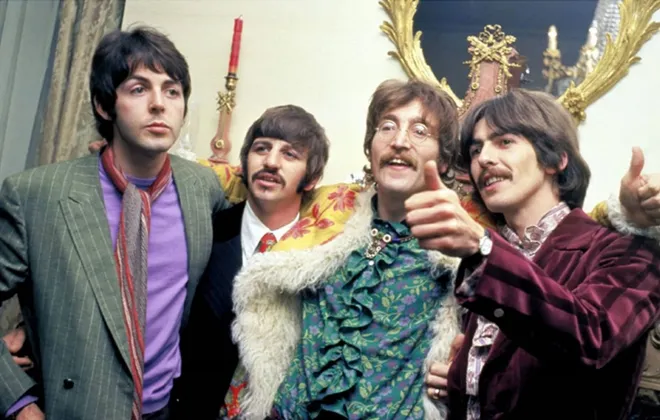
(The Beatles in 1968/Image source: The Cincinnati Enquirer)
This is one of the forgotten Beatles songs, but I love it! I love the guitar riff and the piano, which mimics it. The song was released in 1969 with the Yellow Submarine album. It was probably written by John, although credited to Lennon & McCartney. The song is one of the few Beatles songs that, because they were in that album, are not well known.
During the recording session the Beatles had to put up with the presence of Yoko Ono (well, not for John)…. One interesting note is that this is one of the few songs where Paul does the lower harmony. The other ones are «Come Together» and «I Don’t Want to Spoil the Party«. Another interesting note is that, because it is such a cool song, it has been covered by dozens of bands and performers.
(«Ghostly Faces on the Wall»/Francisco Bravo Cabrera/All Rights Reserved)
“Changing of the Guard” (An Euro-Ku)
These city streets recall my passing and remember my footsteps, on each corner and pass from mouth to mouth stories I had quite forgotten, while faces in the winds blur like smoke, but the echoes of their voices always linger.
I pass greeting the shadows of old promises, my hands reaching for what I had lost, like a crown of fleeting triumphs that precariously balanced on my head.
Moonlight permeates the darkened wall, and the changing of the guard, unseen by only me, leaves behind only the pulse of time.
C.2025 – Francisco Bravo Cabrera – 21 AUG 2025 – Izmir, Türkiye
NOTA BENE
An Euro-Ku is my invention from 2022. As I admire the original Japanese poetry form, I wanted to write in the style. However, being a Westerner and not having the benefit of the Japanese culture, language or history, I felt I could not honour the original Haiku. So I thought it would be beneficial to create a similar form but suited to the European mentality, history and culture. The Euro-Ku still maintains the three stanzas or verses, however, since it is written in English, (or any other European language), it made no sense to stick to the strict syllabic count, which works for Japanese but not for any other language. So there are no syllabic counts or restrictions in the Euro-Ku. Another rule, if I may, is that the verses must flow easily and logically into each other completing the thought and the story. No verse should just flow into outer space. And finally the Euro-Ku must be accompanied by an original, inedited illustration made by the author specifically for the poem.
(«Vino tinto»/Francisco Bravo Cabrera/All Rights Reserved)
Definitely one of the 16th Century masters and a phenomenal representative of Mannerism and the Venetian School. Allow me to introduce to you Tintoretto, «il furioso». Here is what you need to know about this great artist…
(All we kindly ask is that you please like, comment, share and subscribe as it helps our channel)







 JaZzArt en València